

Space telescopes have transformed our understanding of the cosmos by eliminating atmospheric interference and enabling observations at wavelengths inaccessible from Earth’s surface. Instruments such as the James Webb Space Telescope (JWST) represent the pinnacle of ingenuity, combining advanced optics, ultra-sensitive detectors, and precise control systems. Their capacity to peer deep into the early universe allows astronomers to investigate the formation of the first galaxies, the atmospheres of distant exoplanets, and the chemical traces of cosmic origins.
Fundamental Principles of Space Telescope Design
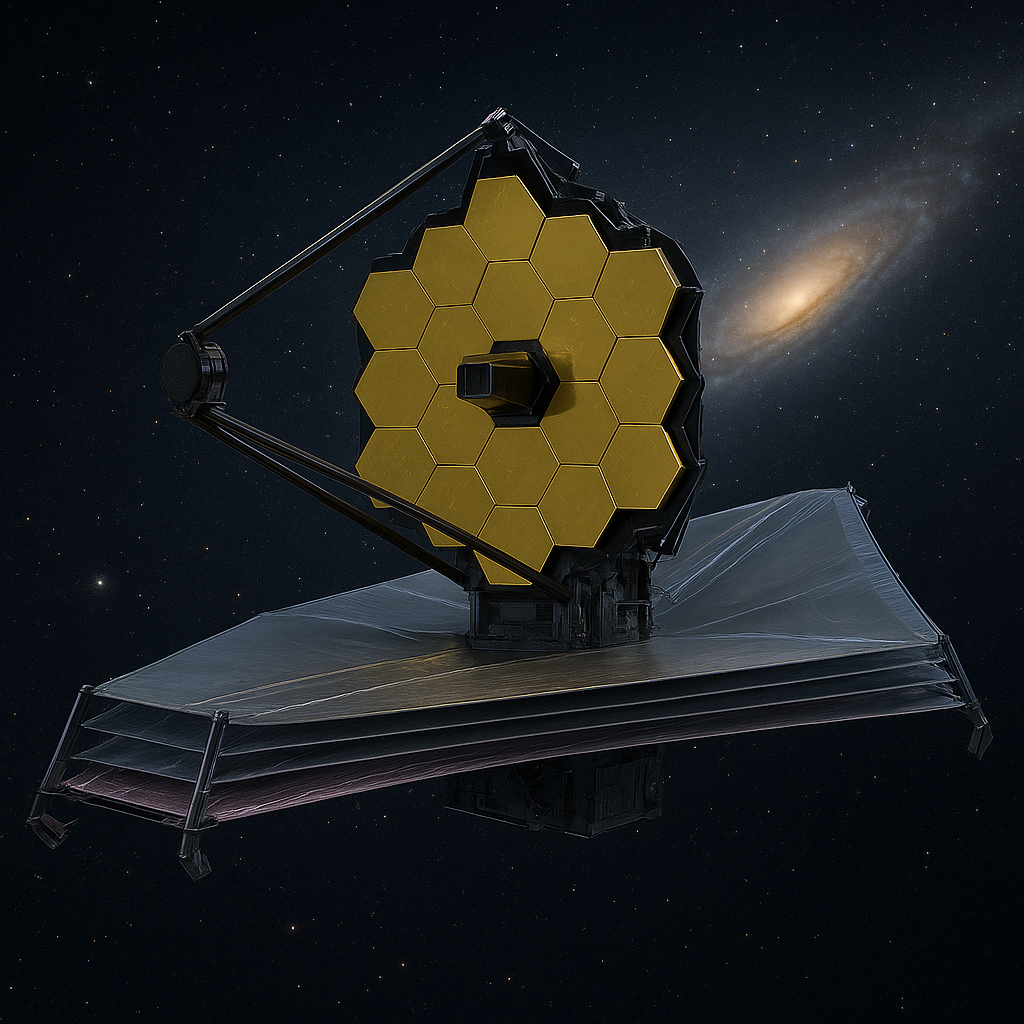
The core objective of any space observatory is to maximize light-gathering capability while maintaining image quality free from terrestrial distortions. A primary component in this endeavor is the mirror assembly. Large segmented mirrors, like those on JWST, fold compactly for launch and deploy in space, forming a single, contiguous reflective surface. This design exploits the relationship between mirror diameter and angular resolution, governed by the equation θ ≈ 1.22 λ/D, where λ is the observed wavelength and D the mirror diameter. Minimizing diffraction effects ensures sharper views of fine cosmic structures.
Optical performance also hinges on rigorous calibration. On-orbit calibration uses reference stars and internal light sources to adjust for thermal shifts, minor misalignments, and detector sensitivities. Without routine calibration, images can suffer from aberrations, pixel-to-pixel variations, and pointing inaccuracies. Complementing this, active wavefront sensing and control systems continuously fine-tune mirror segments, preserving a near-perfect optical wavefront even as the telescope endures temperature fluctuations in space.
Key Technologies in Observing the Cosmos
Modern space telescopes combine multiple subsystems to achieve unprecedented precision and sensitivity across a wide range of wavelengths. Below is an overview of the most critical technologies:
- Infrared Detectors: Arrays of microshutters and long-wavelength sensors cooled to near absolute zero to minimize thermal noise. These detectors are essential for peering through cosmic dust and observing redshifted light from the early universe.
- Ultra-Stable Structures: Materials with low thermal expansion coefficients, such as beryllium and carbon-fiber composites, maintain optical alignment under dramatic temperature changes.
- Sunshield Systems: Multi-layered membranes that block sunlight, enabling instruments to achieve substantially colder operating temperatures and reducing infrared background interference.
- Fine Guidance Sensors (FGS): Star trackers and gyroscopes that lock onto guide stars, allowing the observatory to maintain precise pointing stability within fractions of an arcsecond.
- Spectrometers: Grating and prism-based instruments that disperse incoming light into its constituent spectrum, revealing the chemical composition, temperature, and velocity of celestial objects.
Overcoming Challenges in Deployment and Operation
Launching and operating a space telescope involves a sequence of complex steps, each carrying significant risk. The initial deployment phase requires flawless mechanical operations to unfold and align mirror segments and sunshield layers. For JWST, this meant hundreds of hinge mechanisms actuating in perfect coordination across millions of kilometers from Earth.
Once deployed, thermal management becomes paramount. Solar radiation can introduce temperature gradients that warp optical components. Engineers employ multi-layer insulation, heater circuits, and heat pipes to distribute and dissipate heat. Maintaining cryogenic conditions for infrared sensors demands both passive cooling via sunshields and active refrigeration systems. Any failure in these systems can degrade performance or render instruments inoperable.
Another hurdle is micrometeoroid impacts. Even tiny particles traveling at tens of kilometers per second pose a threat to delicate optical surfaces. Designers mitigate this by incorporating protective coatings and shields, although every added layer must balance mass constraints and launch vehicle limitations.
Scientific Discoveries Enabled by Infrared Observations
Infrared astronomy has unlocked a wealth of discoveries that visible-light telescopes cannot achieve. By observing longer wavelengths, space observatories penetrate dense molecular clouds where stars are born, revealing protostellar clusters and planetary formation processes hidden behind veils of dust. Key breakthroughs include:
- Characterization of exoplanet atmospheres: Infrared spectroscopy detects molecular signatures such as water vapor, methane, and carbon dioxide, offering insights into planetary climate and potential habitability.
- Exploration of the earliest galaxies: Observations at high redshift unveil galaxies forming just a few hundred million years after the Big Bang, shedding light on early star formation rates and galactic evolution.
- Mapping of cosmic web structures: Thermal emission from intergalactic gas filaments can be traced in the infrared, refining our understanding of large-scale matter distribution in the cosmos.
Future Prospects and Missions on the Horizon
The success of JWST paves the way for next-generation observatories designed to probe even fainter signals and wider spectral ranges. Upcoming missions aim to:
- Survey cosmic dawn with ultra-large aperture mirrors exceeding 10 meters in diameter.
- Perform high-contrast imaging of Earth-like exoplanets using advanced coronagraphs and starshades to block starlight and reveal orbiting worlds.
- Integrate interferometry techniques in space, combining light from multiple telescopes to achieve angular resolutions beyond the capabilities of any single mirror.
Advancements in detector materials, autonomous alignment algorithms, and lightweight adaptive optics promise to extend the reach of space-based astronomy even further. As these technologies mature, they will enable researchers to confront intriguing questions in cosmology, dark matter distribution, and the conditions required for life beyond our planet, continuing humanity’s quest to unravel the deepest mysteries of the cosmic frontier.