



The quest to understand the cosmos has driven humanity to innovate beyond Earth’s confines. From the first unmanned probes to ambitious plans for interstellar voyages, robotic systems have become indispensable partners. Their ability to endure harsh environments, perform complex tasks, and relay critical data back to mission control transforms our understanding of distant worlds. This article explores the evolution, current achievements, technological breakthroughs, and future challenges in the realm of robotics applied to deep space exploration.
Evolution of Robotic Spacecraft
Early attempts at unmanned missions were fraught with failures, yet they laid the groundwork for modern triumphs. Launching robotics into orbit began in the late 1950s and 1960s, with the Soviet Luna programme and the American Ranger series paving the way. These pioneers carried rudimentary cameras and instrumentation, proving that automated platforms could survive launch stresses and transmit basic scientific data.
By the 1970s, missions such as Pioneer and Voyager extended our reach to the outer Solar System. Equipped with improved sensors and solar-powered systems, they demonstrated remarkable resilience amid intense radiation belts and frigid temperatures. The success of these spacecraft inspired a new generation of explorers: Galileo, Cassini, and New Horizons, each surpassing the previous achievements in range and complexity.
Over decades, robotics evolved from simple flybys to sophisticated orbiters and landers. The Viking landers of the 1970s conducted the first soil analyses on Mars. In 1997, the Sojourner rover marked humanity’s first wheeled exploration of another planet, showing that remote-controlled vehicles could traverse unknown terrains. These milestones established key principles: modular design, robust communication links, and onboard autonomy for hazard detection.
Current Robotic Missions
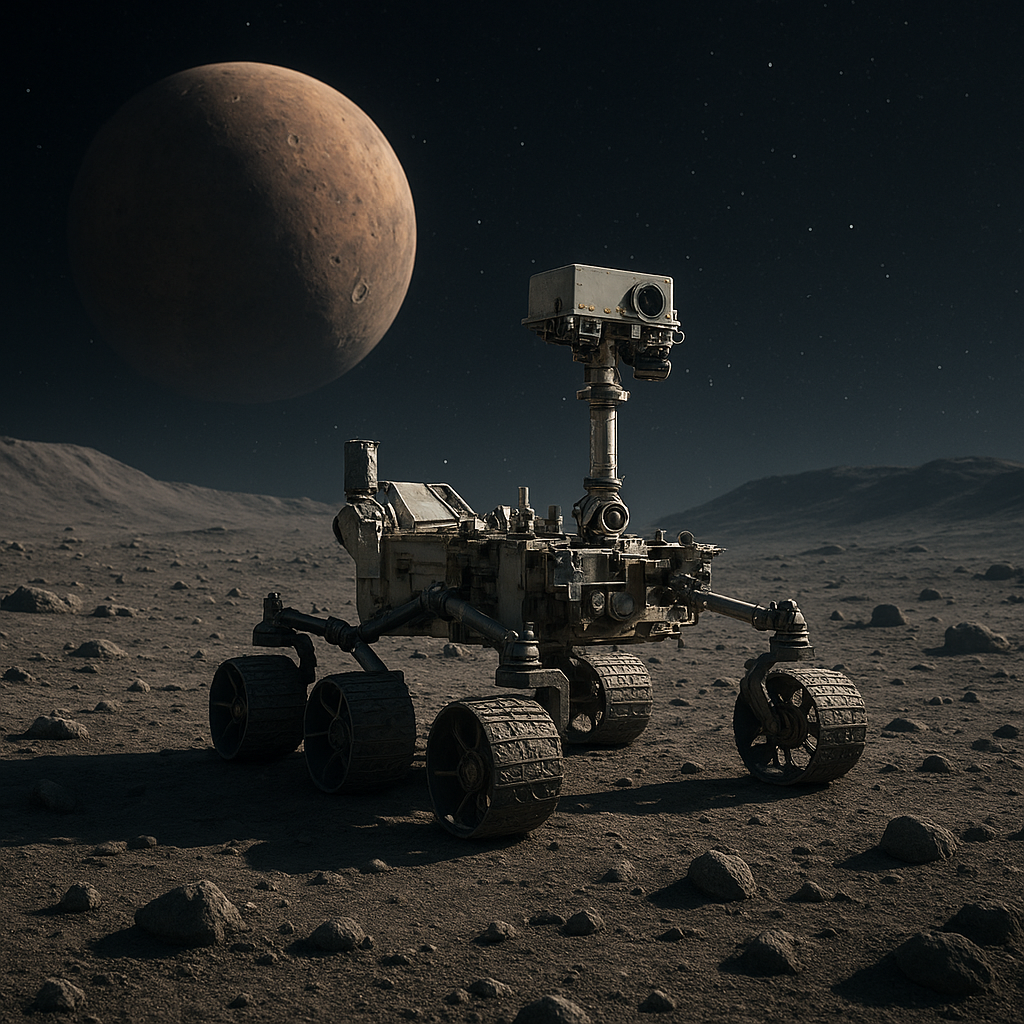
- Mars Rovers: Opportunity, Curiosity, and Perseverance continue to characterize Martian geology and search for signs of past life.
- Juno: Orbiting Jupiter since 2016, studying the gas giant’s magnetic field and polar cyclones.
- Rosetta: Achieved the first orbit and landing on a comet, revealing insights into primordial bodies from the early Solar System.
- New Horizons: After Pluto, this mission is now venturing into the Kuiper Belt to study ancient icy bodies.
These missions highlight key advancements in autonomy and energy management. Curiosity and Perseverance rely on multi-mission radioisotope thermoelectric generators (MMRTGs) to power scientific instruments during dust storms and night cycles. Meanwhile, advanced machine vision algorithms enable rovers to identify obstacles and plan safe routes without continuous input from Earth.
The James Webb Space Telescope, although a space observatory rather than a rover, exemplifies how robotics ensures precise deployment in orbit. Its segmented mirror unfolded flawlessly, a testament to reliable actuators and high-fidelity feedback systems. This underlines the synergy between mechanical engineering and artificial intelligence in orchestrating complex maneuvers millions of kilometers away.
Technological Innovations Driving Progress
Several breakthroughs are propelling deep space robotics to new frontiers. Innovations in materials science yield lighter yet stronger components, reducing launch costs while enhancing structural integrity. Developments in radiation-hardened electronics protect sensitive circuits from cosmic rays that could otherwise induce mission-ending errors.
Next-generation sensors combine spectrometers, lidar, and hyperspectral cameras to characterize the composition of planetary surfaces and atmospheres. These instruments rely on advanced data processing units that compress and prioritize information, optimizing limited bandwidth for valuable scientific returns. Enhanced propulsion systems, such as solar electric thrusters and proposed nuclear thermal rockets, promise faster transit times and greater maneuverability in deep space environments.
Robotic arms and drills equipped on landers and rovers have grown more dexterous and precise. Perseverance’s SHERLOC instrument uses a laser to detect organic compounds within rock layers, while ExoMars Rosalind Franklin rover will employ a 2-meter drill to extract subsurface samples. The integration of autonomous decision-making software allows these manipulators to adapt their operations in response to unanticipated soil properties or topographical features.
Future Prospects and Challenges
Ambitious plans outline missions to icy moons such as Europa and Enceladus, where subsurface oceans may harbor conditions suitable for life. Proposed robotic landers must penetrate thick ice shells and deploy submersibles to explore hidden aquatic worlds. This will require breakthroughs in thermal melting probes, tethered or untethered swimming robots, and reliable long-distance communication relays through ice layers.
Beyond the outer planets, conceptual designs for interstellar probes aim to reach Alpha Centauri using light sails propelled by high-powered lasers. Although these projects remain in preliminary stages, they underscore the importance of miniaturization and extreme energy efficiency. In such endeavors, each gram of mass and each watt of power must be optimized to sustain mission objectives over decades.
Ensuring the survival of robotic explorers entails rigorous testing under simulated cosmic conditions. Engineers employ vacuum chambers, thermal cycling, and radiation facilities to validate hardware resilience. Meanwhile, software engineers refine fault-tolerant architectures that can detect anomalies, isolate faulty subsystems, and initiate recovery procedures without human intervention.
As mankind pushes further into the void, robotics will remain at the forefront of discovery. Their capacity to endure, adapt, and perform intricate tasks in hostile environments is unmatched. By advancing these technologies, we edge closer to unraveling the universe’s deepest mysteries and perhaps one day establishing sustainable outposts on distant worlds, bridging the gap between our home planet and the infinite expanse beyond.