




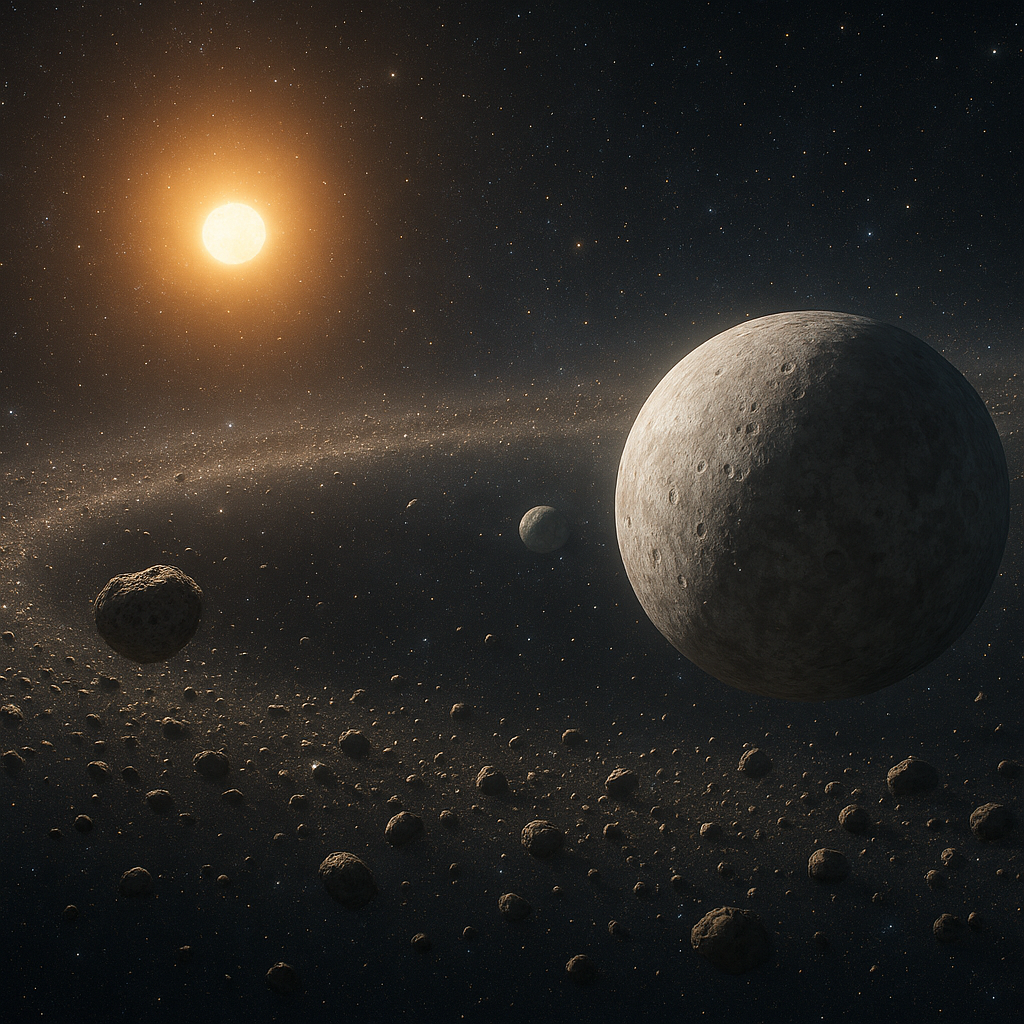
The Kuiper Belt represents one of the most enthralling regions of our Solar System, stretching beyond Neptune’s orbit and harboring a vast population of icy bodies and remnants from its earliest days. This frozen frontier has captivated astronomers and space enthusiasts alike, providing unique insights into the processes that shaped planetary systems. As investigations continue to unveil its secrets, the Belt’s significance extends from understanding the Solar System’s history to guiding future missions that might venture into these distant realms.
Discovery and the Outer Frontier
The idea of a population of objects beyond Neptune emerged in the mid-20th century, as astronomers sought explanations for orbital irregularities in the outer planets. Jan Oort’s hypothesized cloud of comets hinted at distant reservoirs, but it wasn’t until 1992 that the first direct observation of a trans-Neptunian object (1992 QB1) confirmed a new region rich in icy bodies. Since then, improvements in telescope sensitivity and digital imaging have led to the detection of thousands of Kuiper Belt Objects (KBOs), ranging in size from small boulders to bodies rivaling Pluto.
Ground-based surveys, such as those conducted with the Subaru Telescope, have systematically scanned the ecliptic plane, identifying faint moving points of light. Meanwhile, space-based observatories have refined our understanding of KBO orbits and surface properties. The historic flyby of Pluto by the New Horizons spacecraft in 2015 transformed our view of these distant worlds, revealing a complex landscape of mountains, plains, and potential cryovolcanic features. Beyond Pluto, New Horizons continued its journey to explore Arrokoth, a cosmic time capsule preserving the earliest building blocks of our Solar System.
Composition and Dynamic Structure
The Kuiper Belt’s composition offers crucial clues about the raw materials that contributed to planetary formation. Many KBOs consist primarily of water ice, mixed with frozen methane, ammonia, and other volatile compounds. Spectroscopic observations have confirmed the presence of complex organics—so-called tholins—on several surfaces, giving them a characteristic reddish hue. These molecules may have been delivered to the inner Solar System via cometary impacts, potentially influencing the emergence of life on Earth.
Kuiper Belt dynamics are governed by gravitational interactions with Neptune and other giant planets, leading to a variety of orbital configurations:
- Resonant objects, such as those in 3:2 resonance with Neptune (Plutinos), share orbital periods that prevent close encounters with the planet.
- Classical belt members, or “cubewanos,” maintain relatively stable, low-eccentricity orbits between 42 and 48 AU.
- Scattered disk objects exhibit highly eccentric, inclined orbits as a result of past gravitational scattering, extending their aphelia to hundreds of astronomical units.
In addition, the Belt exists within the Sun’s heliosphere, where solar wind particles interact with its outermost constituents. Studies of dust production and collision rates among KBOs help refine models of debris generation and redistribution, offering parallels to debris disks observed around other stars.
Notable Kuiper Belt Objects and Dwarf Planets
- Pluto: Once the ninth planet, now recognized as a dwarf planet, Pluto features a diverse surface of nitrogen glaciers, mountainous terrains, and a tenuous atmosphere. Its five known moons, including Charon, form a unique binary system.
- Eris: Slightly more massive than Pluto, Eris resides in a highly eccentric orbit. Its discovery in 2005 sparked the debate that led to the redefinition of planetary status.
- Haumea: Distinguished by its elongated, ellipsoid shape and rapid rotation, Haumea’s surface displays crystalline water ice and two tiny moons.
- Makemake: Characterized by a red surface likely coated with ethane and methane ices, Makemake has a near-circular orbit and may possess a tenuous atmosphere.
- Arrokoth: A contact binary visited by New Horizons, Arrokoth preserves the primordial configuration of planetesimals that coalesced into larger bodies.
These objects offer windows into the diversity of outcomes that arise from the same initial protoplanetary conditions. Each KBO’s mass, shape, and surface composition reflect a unique evolutionary path shaped by collisions, radiation processing, and thermal history.
Scientific Significance and Future Exploration
Studying the Kuiper Belt advances our understanding of Solar System evolution, exoplanetary systems, and the origin of water and organic compounds on terrestrial worlds. The Belt’s population serves as a reservoir for short-period comets, linking distant icy realms to inner Solar System activity. Analyses of KBO cratering records provide chronological markers to gauge impact rates across billions of years.
Future missions aim to expand upon New Horizons’ legacy:
Extended Flybys and Probes
Proposals for next-generation spacecraft focus on targeted flybys of additional KBOs, equipped with advanced spectrometers and dust analyzers. These instruments would measure isotopic ratios to trace the origin of volatiles and assess the potential for cryovolcanism in subsurface oceans.
Orbital Platforms
Long-duration orbiters stationed in the outer Solar System could conduct continuous monitoring of the Kuiper Belt’s dynamic environment. By studying dust fluxes, micrometeoroid impacts, and magnetospheric interactions, such platforms would deepen our insight into the interplay between solar activity and distant icy bodies.
Sample Return Concepts
While technically challenging, robotic missions capable of collecting and returning KBO material to Earth have been proposed. Even minuscule samples could revolutionize our knowledge of primordial chemistry, offering direct evidence of the building blocks that led to planetary systems.
As technology advances and interest in the outer Solar System grows, the Kuiper Belt stands as a frontier rich in discovery. Its frozen worlds and lingering mysteries beckon astronomers and engineers to design missions that will probe these farthest reaches, revealing the true extent of our cosmic neighborhood.