



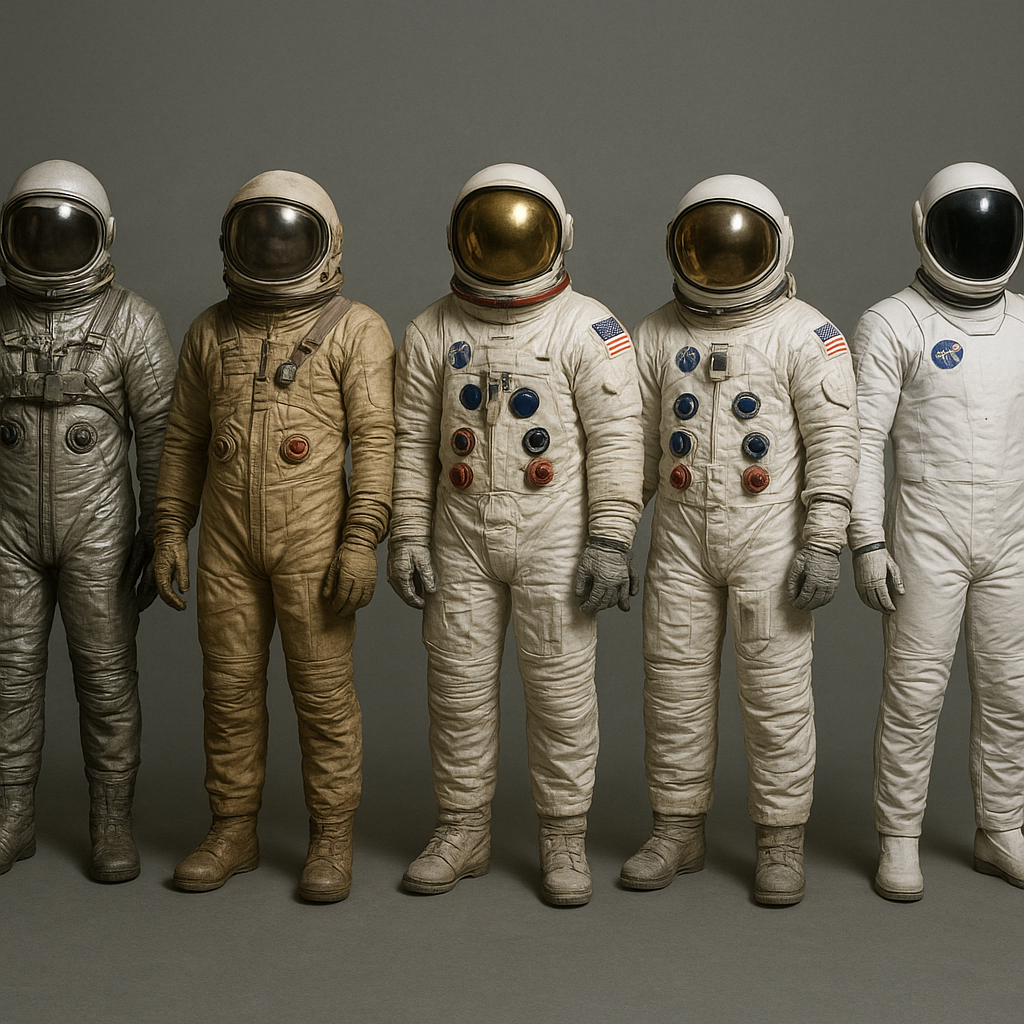
The evolution of spacesuits stands as a testament to human ingenuity and the relentless pursuit of exploration. From rudimentary pressure garments to highly sophisticated extravehicular systems, each iteration has pushed the boundaries of engineering and human endurance. This article traces the remarkable journey of spacesuits, highlighting the breakthroughs that enabled astronauts to survive and work in the harshest environment known to humankind.
Early Origins and Mercury Era
Long before the first human ventured into orbit, inventors and scientists experimented with pressure suits to protect pilots at high altitudes. These prototypes laid the groundwork for the first true spacesuits used in Project Mercury.
High-Altitude Pressure Suits
- The 1930s saw the birth of pressure suits for test pilots, featuring layered rubber and fabric to maintain cabin pressure.
- Equipment was bulky and inflexible, offering minimal mobility but vital life support above 50,000 feet.
Mercury A7L Design
By the late 1950s, NASA’s engineers crafted the A7L suit for the Mercury program. It introduced key features:
- Multi-layered insulation to combat temperature extremes.
- Integrated helmet and visor assembly for micrometeoroid protection.
- Connected gloves with wrist bearings, improving hand articulation.
This suit balanced safety and function, allowing astronauts like John Glenn to orbit the Earth in 1962.
Apollo Era: Giant Steps for Mankind
The Apollo program demanded spacesuits capable of supporting lunar surface activities. Engineers faced the challenge of creating a suit that combined life support with surface exploration capabilities.
Enhanced Mobility and Life Support
- The A7LB model introduced a portable life support system (PLSS) backpack, providing oxygen, cooling, and CO₂ removal.
- Joint bearings at shoulders, elbows, hips, and knees offered unprecedented mobility for moonwalks.
Materials and Layers
To endure abrasive lunar dust and solar radiation, Apollo suits featured:
- An outer layer of aluminized Mylar and materials like Teflon for abrasion resistance.
- Neoprene-coated nylon bladder to hold pressure.
- Thermal micrometeoroid garment for shielding against submillimeter particles.
These innovations allowed astronauts to collect samples, deploy experiments, and plant the American flag on the Moon’s surface.
Space Shuttle and International Space Station
Transitioning from lunar landings to long-duration missions in low Earth orbit, spacesuits evolved into modular platforms supporting diverse tasks, including assembly and maintenance of the Space Shuttle and International Space Station (ISS).
Extravehicular Mobility Unit (EMU)
- The EMU became the primary suit for spacewalks, offering up to eight hours of continuous operation.
- Features included detachable gloves, adjustable boots, and a robust PLSS with enhanced cooling and power.
Design for Longevity
Operating in microgravity introduced new requirements:
- Improved thermal regulation via a liquid cooling and ventilation garment.
- Redundant safety systems to address unexpected failures during repairs.
- Compatibility with airlock interfaces and vehicle communications.
Over decades, the EMU’s modular architecture enabled in-orbit servicing, demonstrating the value of customization and upgrade paths for long-term missions.
Modern Developments and Future Prospects
As humanity sets its sights on Mars and beyond, next-generation suits must meet even more rigorous demands. Cutting-edge research focuses on enhanced flexibility, improved life support, and integration with robotic assistants.
Next-Generation Concepts
- Smart fabrics embedded with sensors to monitor astronaut health and suit integrity in real time.
- Advanced composite layers providing superior micrometeoroid and radiation shielding.
- Modular exoskeleton elements to boost strength and reduce fatigue during planetary exploration.
International Collaboration
Programs like Artemis and partnerships with commercial entities emphasize global cooperation:
- Shared research on closed-loop life support systems to recycle water and oxygen.
- Standardized suit interfaces for interoperability across spacecraft.
- Joint testing facilities to validate extravehicular operations in simulated Martian terrain.
These efforts illustrate the relentless pursuit of innovation and the application of advanced cosmic exploration technologies, ensuring that future explorers will operate with greater safety, comfort, and effectiveness.