




The pursuit of cost-effective and sustainable access to orbit has driven rapid advancements in rocket design. Modern aerospace companies are revolutionizing how rockets are built, launched, recovered, and refueled. By embracing innovative materials, cutting-edge propulsion systems, and novel refueling strategies, engineers are turning once-expendable launch vehicles into truly reusable assets. This article explores the technical breakthroughs behind rocket reusability, the emerging methods for in-space and on-pad refueling, and the transformative impact on future missions.
Innovations in Rocket Reusability
Designing for Multiple Flights
Traditional rockets operated under an “expendable” paradigm, discarding key components after a single mission. The shift toward sustainability demanded a radical rethink of structural and thermal loads. Modern stages incorporate high-strength alloys and composite materials, dramatically reducing mass while enhancing durability. Lightweight interstage rings, thermal protection tiles, and grid fins work in concert to ensure each booster can survive reentry and landing.
Recovery Mechanisms and Technologies
Recovering a rocket stage intact requires a finely tuned choreography of aerodynamic control and propulsion. Key innovations include:
- Grid fins made of titanium or composite materials to steer the returning stage through the atmosphere.
- Deployable landing legs with shock-absorbing mechanisms to absorb touchdown forces.
- Precision guidance systems combining GPS, inertial measurement units, and optical sensors for pinpoint landings.
Companies like SpaceX pioneered vertical landings on autonomous drone ships, while others experiment with winged boosters that glide back to a runway. Each approach centers on minimizing cost per flight by maximizing the number of reuses.
Advanced Refueling Techniques
On-Pad Propellant Loading
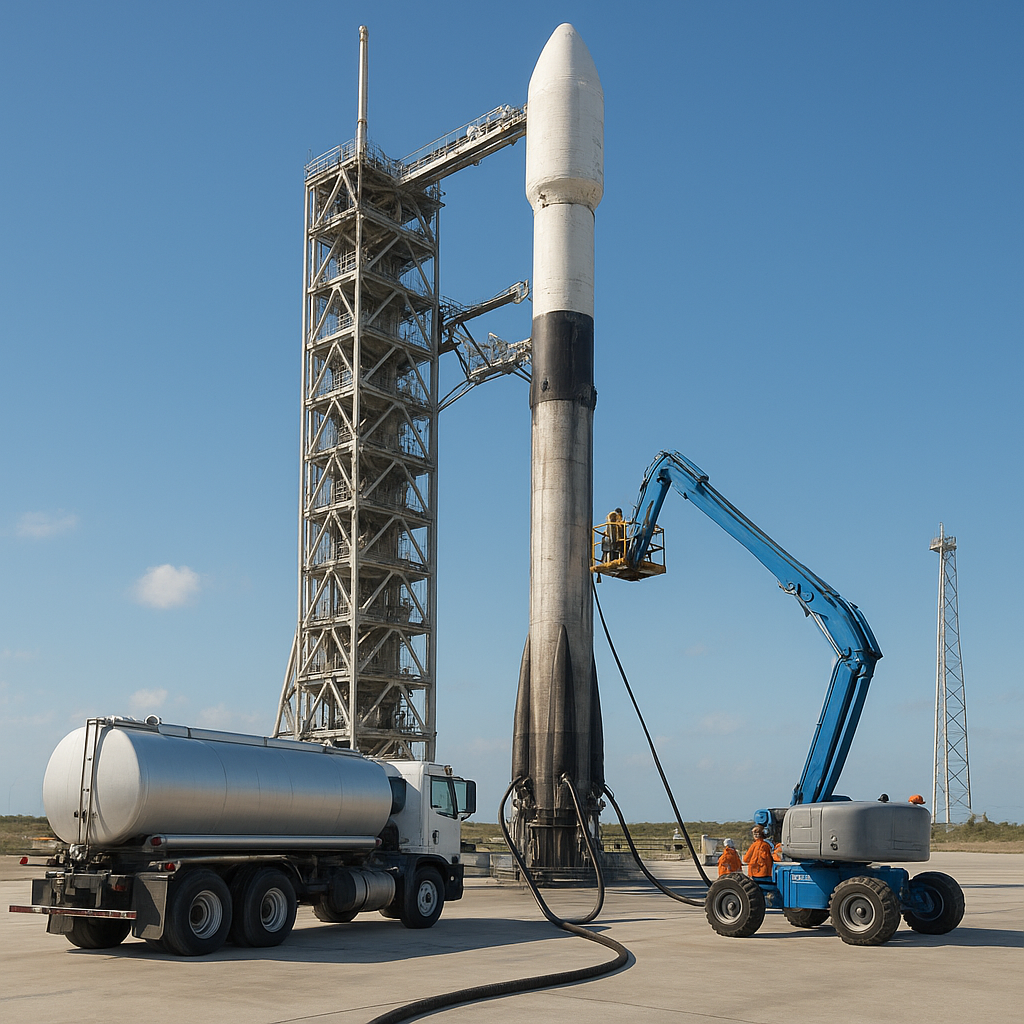
Regular launch pads have evolved to handle faster turnarounds. Automated cryogenic propellant lines, robotic valves, and fault-tolerant control systems ensure rapid, safe fueling of both first and second stages. Key elements include:
- High-capacity propellant storage tanks with subcooled liquid oxygen and densified methane or RP-1.
- Automated chill-down procedures to avoid thermal shock in transfer lines.
- Integrated leak-detection sensors and real-time telemetry to prevent anomalies.
In-Orbit Refueling: Concepts and Challenges
Long-duration missions beyond low Earth orbit demand in-space refueling to extend vehicle life and payload capacity. Current research focuses on two primary methods:
- Depot architecture: Centralized fuel stations in orbit where spacecraft dock to transfer cryogenic propellants.
- Tank swap-out: Modules are refilled on the ground and launched as self-contained propellant carriers.
Each technique faces significant hurdles, including fluid management in microgravity, thermal control to prevent boil-off, and precise docking maneuvers. Project teams use active cooling systems, zero-boil-off tank designs, and magnetic coupling interfaces to maintain propellant integrity and safety.
Implications for Space Exploration
Reducing Mission Costs and Turnaround Times
By refueling and reusing rocket elements, launch providers can slash operational expenses and increase launch cadence. Estimates suggest reuse can lower per-launch costs by up to 60 percent compared to expendable systems. Faster integration cycles on the ground, coupled with minimal refurbishment of returned stages, allow more frequent missions to satellite constellations, research platforms, and crewed outposts.
Enabling Deep-Space Missions
For voyages to the Moon, Mars, and beyond, in-space refueling and reusable assets are indispensable. Spacecraft can depart low Earth orbit with partial loads, top off at a fuel depot, and proceed with maximum efficiency. This strategy:
- Reduces the launch mass required from Earth, lowering launch costs and stress on hardware.
- Allows modular mission architectures, where separate vehicles specialize in transport, habitation, or cargo delivery.
- Improves mission resilience by providing contingency fuel reserves.
Future Trajectories in Aerospace Engineering
The road ahead features ambitious goals such as reusable upper stages, air-breathing rocket engines, and combined-cycle propulsion systems. Integrating rocket motors with jet turbines could enable single-stage-to-orbit vehicles that take off horizontally and land like an aircraft. Such breakthroughs depend on ongoing advancements in thermodynamics, materials science, and engineering disciplines.
Operational and Environmental Benefits
Logistical Advantages
Ground operations become more streamlined when vehicles return intact. Launch pads and integration facilities can be designed around a fleet of similar boosters, standardizing maintenance procedures and reducing lead times. Workforce training focuses on inspection and rapid turnaround rather than manufacturing from scratch.
Environmental Impact
Reusability directly contributes to a smaller environmental footprint. Producing fewer rocket stages translates to lower raw material consumption and reduced waste. Furthermore, cleaner propellants such as liquefied natural gas or liquid hydrogen cut down on atmospheric pollutants during launch. The combined effect aligns with global efforts to minimize anthropogenic impacts on the universe we study and explore.
Case Study: Next-Generation Booster Programs
Heavy-Lift Vehicle Reuse
Emerging heavy-lift vehicles aim to repurpose not just first stages but also core and booster segments of super-heavy architectures. Modular design philosophies allow each booster to detach and return independently. Innovations include harsh-environment coatings to withstand interstage separation forces, and enhanced avionics for multi-axis control during descent.
Collaborative Industry Efforts
Public-private partnerships accelerate development by pooling expertise and sharing risks. Space agencies, research laboratories, and commercial firms collaborate on joint testbeds for cryogenic refueling and autonomous docking. Such alliances foster rapid iteration, bringing the dream of fully reusable, in-space serviced rockets ever closer to reality.
Emerging Trends and Final Thoughts
Artificial Intelligence and Predictive Maintenance
Machine learning algorithms analyze sensor data from each flight to predict wear patterns and detect anomalies before they become critical. This efficiency-boosting strategy reduces unexpected downtime and optimizes refurbishment workflows.
The Role of International Collaboration
Global initiatives seek to standardize refueling interfaces and docking mechanisms, ensuring interoperability across different nations’ spacecraft. Such standards pave the way for multinational fuel depots and joint lunar or Martian missions, promoting a cooperative approach to exploring the cosmos.
The convergence of technology, materials innovation, and strategic refueling promises a new era in which rockets depart and return as true assets rather than disposable tools. As these practices mature, the vision of regular, sustainable travel to lunar bases, Martian colonies, and beyond moves from aspiration to operational reality.