
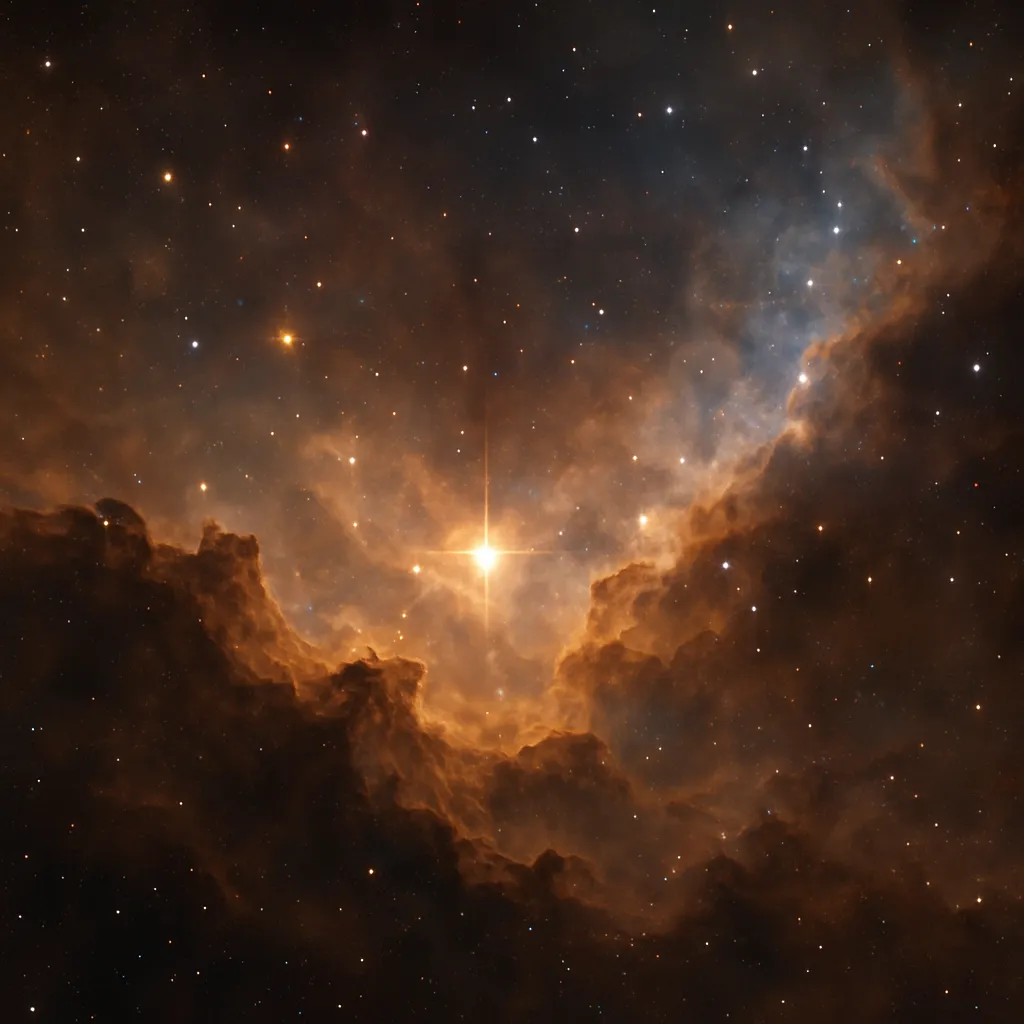
Interstellar space, often perceived as an empty void, is in reality teeming with minute particles that collectively drive the lifecycle of stars. These tiny constituents, known as dust grains, serve as the building blocks and catalysts for stellar birth, bridging vast cosmic distances with their profound influence on gas dynamics and chemistry. By examining the origins, physical properties, and transformative roles of these particles, we reveal how the dance between gas and solid matter ignites the process of star formation and shapes the architecture of galaxies.
Interstellar Dust: Composition and Origins
The universe’s particulate component consists of silicate and carbonaceous solids, layered with icy mantles that accumulate in the densest regions. These interstellar dust grains range in size from a few nanometers to micrometers, comparable to smoke particles on Earth. Their provenance traces back to powerful stellar events:
- Supernovae explosions that disperse heavy elements synthesized in massive stars.
- Asymptotic giant branch (AGB) stars ejecting dust-rich winds at the end of their lives.
- Grain growth within cold molecular clouds through surface reactions.
Once formed, these grains are subject to sputtering by cosmic rays, coagulation via mutual collisions, and accretion of simple molecules like water and ammonia. They also play a protective role, shielding fragile molecules from harsh ultraviolet radiation.
Dust Grains as Star-Formation Catalysts
Energy Dissipation and Cooling Mechanisms
Efficient cooling is imperative for a collapsing cloud to fragment and condense into protostars. Gas alone cannot radiate away heat rapidly; it requires the presence of dust grains to absorb thermal energy and re-emit it in longer wavelengths. The process involves collisions between gas particles and solid surfaces, where kinetic energy is converted to infrared photons. This mechanism ensures that dense regions can reach temperatures low enough to overcome internal pressure, leading to gravitational collapse.
Molecular Hydrogen Formation and Chemistry
One of the most significant chemical processes facilitated by dust is the synthesis of molecular hydrogen (H₂), the universe’s most prevalent molecule. In the sparse interstellar medium, two hydrogen atoms rarely meet without a third body to carry away excess energy. Dust grains provide this third surface, allowing atoms to stick, encounter each other, and bond. Beyond H₂, surfaces host complex networks of reactions that build organic molecules and ices, fostering the chemical richness observed in protoplanetary disks and cometary bodies.
Magnetic Fields and Dust Dynamics
Magnetic forces intertwine with particulate motion, influencing cloud stability and angular momentum transport. Dust grains, often elongated or irregularly shaped, can align their longest axes perpendicular to local field lines. This alignment causes polarized emission in the submillimeter regime, which astronomers detect to infer the geometry and strength of galactic magnetic fields. By analyzing polarized light, researchers map field lines that regulate collapse pathways and channel matter toward protostellar cores.
- Alignment mechanisms include radiative torques from anisotropic starlight.
- Grain charging alters coupling efficiency between dust and magnetic fields.
- Magnetohydrodynamic (MHD) flows redistribute momentum during collapse.
The interplay between magnetic tension and gravity determines whether a cloud will fragment into multiple stars or form a solitary massive body. Dust grains, through their alignment and interaction with fields, become silent architects of the final stellar configuration.
Observational Techniques and Future Prospects
Infrared and Submillimeter Astronomy
Since dust absorbs ultraviolet and visible photons, its thermal emission peaks in the infrared to submillimeter wavelengths. Space-based observatories equipped with sensitive detectors, such as the Herschel and Spitzer Space Telescopes, revolutionized our view by peering through obscuring layers and revealing embryonic stellar nurseries. High-resolution maps of emission allow scientists to trace density variations, identify pre-stellar cores, and estimate mass distributions within molecular clouds.
Computational Simulations
Advanced numerical models integrate hydrodynamics, chemistry, and radiative transfer to simulate the collapse of dust-laden clouds. These simulations track millions of particles under varying initial conditions, predicting observable signatures that guide telescope observations. Models incorporate detailed grain size distributions, chemical reaction networks on surfaces, and feedback from emerging protostars. By comparing synthetic observables with real data, researchers refine theories on dust evolution and star-formation efficiency.
- Coupled gas-dust dynamics under gravitational instability.
- Feedback processes from stellar winds and radiation pressure.
- Formation of circumstellar disks and eventual planetesimal accretion.
Challenges and Emerging Frontiers
Despite significant progress, many mysteries persist. The precise nucleation pathways for the first dust grains in the early universe remain elusive. We still lack a complete understanding of grain surface chemistry at ultralow temperatures, and the role of very small nanoparticles in seeding large-scale structures continues to spark debate. Upcoming missions, such as the James Webb Space Telescope and next-generation radio arrays, promise to deliver unprecedented sensitivity and spatial resolution.
As we refine laboratory techniques to measure reaction rates at interstellar conditions and develop more sophisticated MHD codes, the synergy between observation and theory will illuminate the nuanced roles of dust. From the minute coalescence of atoms on cold surfaces to the grand emergence of blazing stars, these humble particles guide the cosmic narrative of creation.