




Peering into the vastness of our home galaxy presents one of astronomy’s most intricate puzzles. Embedded within the swirling disk of the Milky Way, our Solar System cannot step back to survey the overall structure. Yet, through ingenious techniques and cutting-edge instruments, scientists have crafted a remarkably detailed model of this cosmic island. This article delves into the methods used by astronomers as they stitch together a 3D mapping of our galaxy, revealing its arms, bulge, halo, and hidden mass.
The Challenge of Galactic Cartography
The Milky Way spans roughly 100,000 light-years in diameter and harbors between 100 and 400 billion stars. Living inside its disk poses an immediate hurdle: dust, gas, and the sheer density of stars obscure our view. Unlike external galaxies that can be photographed from afar, astronomers must piece together indirect clues. Key obstacles include:
- Interstellar dust extinction blocking visible light
- Complex motion of stars and gas within the gravitational potential
- Line-of-sight confusion when objects at different distances overlap
Yet overcoming these challenges has led to breakthroughs in our understanding of Mapping the Milky Way, revealing not only its luminous regions but also the dark mass that holds it together.
Measuring Distances Across the Galaxy
Geometric Parallax
The most fundamental method is stellar parallax, where Earth’s orbit around the Sun provides differing viewpoints. By tracking the minute angular shift of a star against more distant background objects, astronomers can triangulate its distance. The ESA’s GAIA mission has measured parallax for over a billion stars with unprecedented precision, extending reliable distance estimates to several thousand light-years.
Standard Candles: Variable Stars
Variable stars like Cepheids and RR Lyrae pulsate with periods tied to their intrinsic brightness. By monitoring light curves, scientists infer absolute luminosity and compare it to observed brightness to calculate distance. These pulsating stars serve as mileposts well beyond parallax limits, mapping the galactic disk and outskirts up to tens of thousands of light-years away.
Masers and Radio Interferometry
Natural cosmic masers—microwave amplifiers found in star-forming regions—can be tracked using very long baseline interferometry (VLBI). VLBI links radio telescopes across Earth to achieve exceptional angular resolution. By measuring parallax on masers, astronomers establish accurate distances to high-mass star-forming complexes, anchoring the spiral arm geometry.
Tip of the Red Giant Branch and Other Indicators
The tip of the red giant branch (TRGB) method uses the predictable luminosity at which aging stars ignite helium. This standard brightness marker extends distance estimates to remote satellites and the far reaches of the halo. Other tools include planetary nebula luminosity functions and surface brightness fluctuations in dense star clusters.
Revealing Galactic Structure
Mapping the Spiral Arms
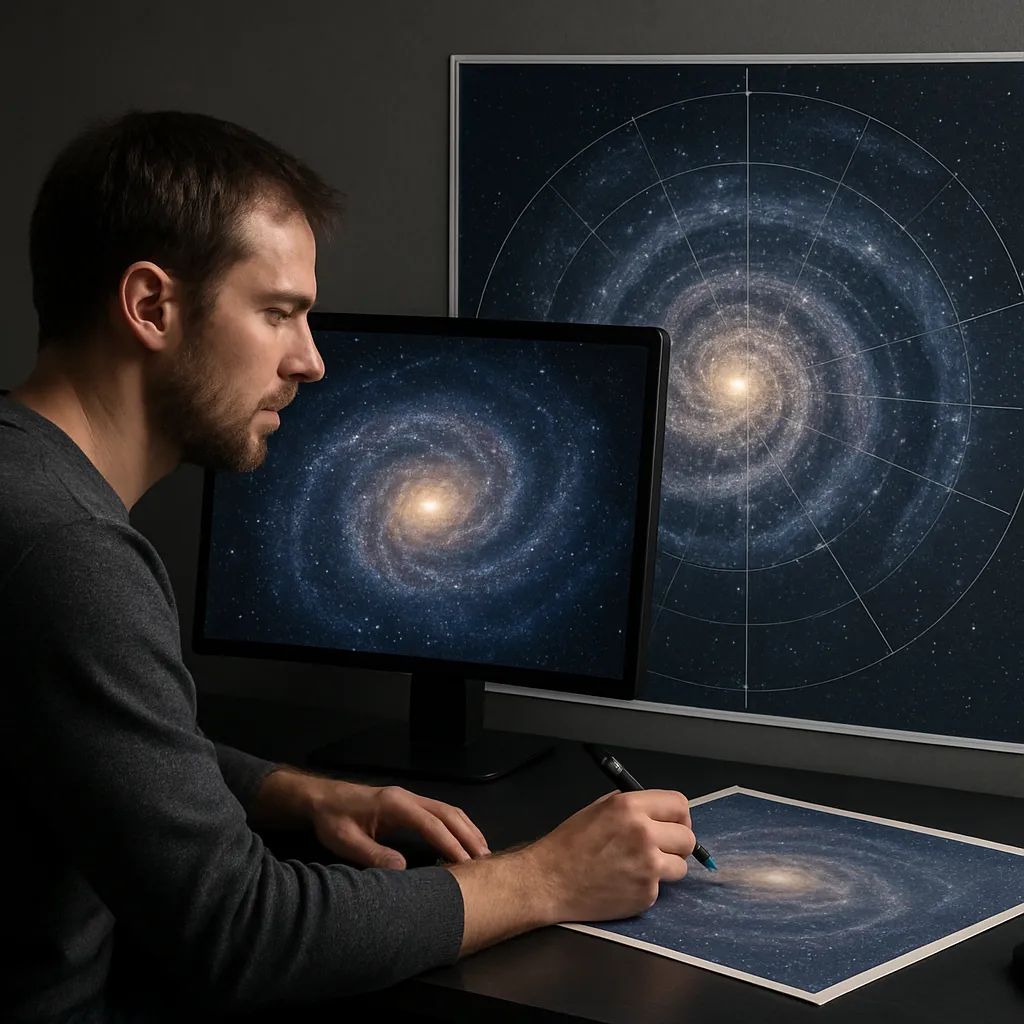
Combining distance markers yields a blueprint of the Milky Way’s spiral arms. Radio surveys of neutral hydrogen (HI) and molecular gas (CO) trace the interstellar medium, while masers and young clusters outline active star-forming zones. These data reveal at least four primary arms—Perseus, Sagittarius, Scutum–Centaurus, and the Outer Arm—and several smaller spurs.
The Central Bulge and Bar
Infrared observations pierce the dust-shrouded core, uncovering a densely packed bulge and an elongated bar structure. Missions such as Spitzer and the VISTA survey map the distribution of red giant stars, charting a bar roughly 27,000 light-years long. Kinematic studies confirm that stars in this bar follow elongated orbits, influencing gas flows and star formation in the inner galaxy.
Stellar Halo and Dark Matter
Beyond the disk lies a diffuse stellar halo, hosting globular clusters and streams from disrupted dwarf galaxies. Mapping the motions of halo stars with GAIA data reveals the gravitational influence of dark matter. By modeling the velocity distribution, astronomers infer a massive, roughly spherical dark halo enveloping the luminous components.
Advanced Surveys and Computational Techniques
All-Sky Photometric and Spectroscopic Projects
Large-scale surveys such as the Sloan Digital Sky Survey (SDSS) and the Dark Energy Survey (DES) collect multiband photometry for millions of stars. Spectroscopic follow-ups, like APOGEE and LAMOST, measure stellar chemical abundances and radial velocities. These data sets feed into sophisticated data analysis pipelines, disentangling overlapping populations and identifying substructures within the disk and halo.
Machine Learning and Modeling
With petabytes of observations, artificial intelligence plays a growing role. Machine learning algorithms classify stars by spectral type, estimate distances where direct measures fail, and detect subtle patterns indicative of past mergers. Dynamic models simulate galaxy evolution, matching observed stellar motions to test theories of formation and the distribution of both visible and invisible mass.
Future Horizons in Galactic Mapping
Upcoming instruments promise to refine our view of the Milky Way. The Square Kilometre Array (SKA) will expand maser parallax studies and map neutral hydrogen in unprecedented detail. The Vera C. Rubin Observatory’s Legacy Survey of Space and Time (LSST) will monitor billions of stars, capturing transient events and refining infrared extinction maps. Meanwhile, next-generation space telescopes will probe the galactic center’s dense regions with higher resolution and sensitivity.
Together, these efforts herald a new era of precision galactic cartography, offering ever-clearer insights into the structure, history, and unseen forces shaping our cosmic neighborhood.