
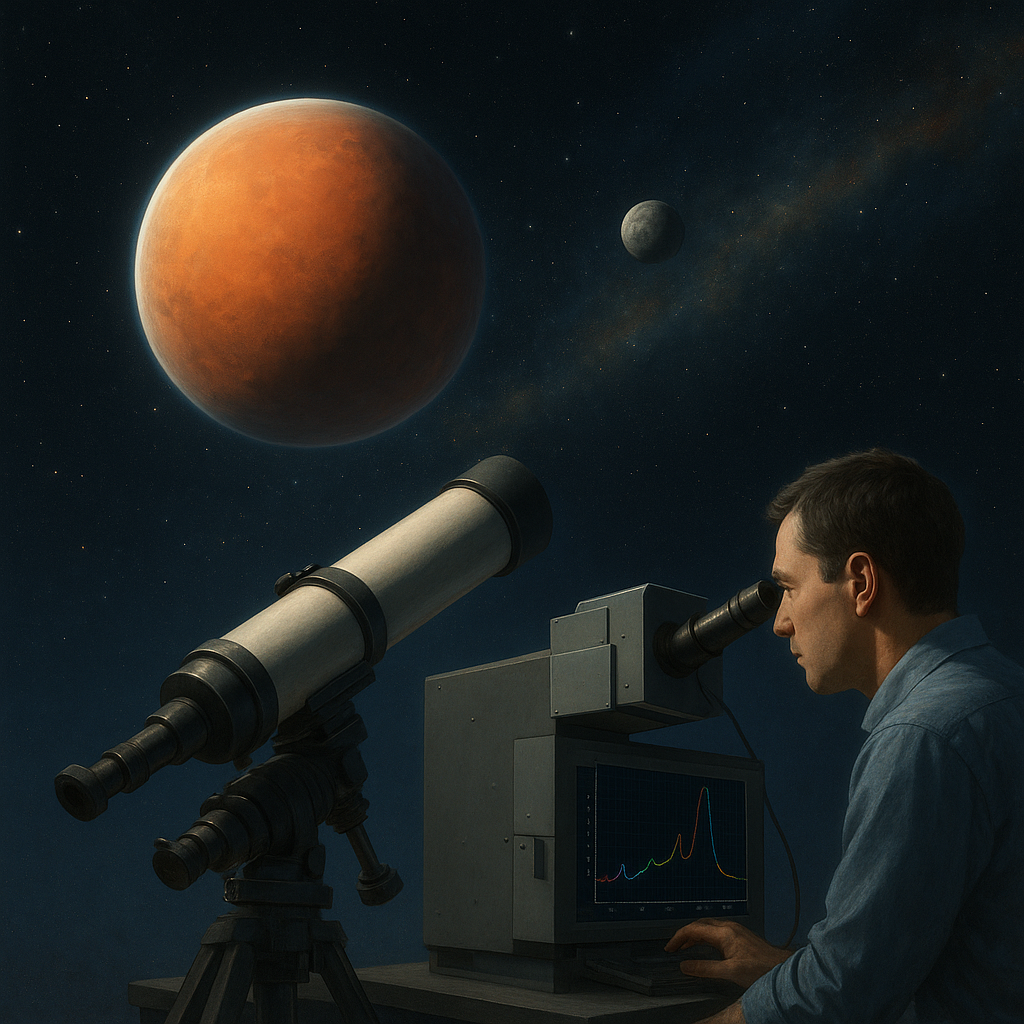
Astronomers have made remarkable strides in uncovering the secrets of worlds orbiting distant stars. By peering across the void of space, they glean insights into the atmosphere enveloping these far-off orbs, revealing clues about their composition, climate, and potential habitability. This article delves into the key methods and technologies that enable the detection and characterization of exoplanetary atmospheres, exploring how light traverses space, interacts with gas layers, and carries the fingerprints of alien molecules back to Earth’s observatories.
Principles of Atmospheric Spectroscopy
At the heart of atmospheric exploration lies the science of spectroscopy, the study of how matter interacts with wavelengths of light. When starlight passes through an exoplanet’s atmosphere, certain wavelengths are absorbed by gases present in that layer. The resulting spectrum—an array of dark lines and bright regions—acts as a barcode, pinpointing the unique chemical signatures of elements like water vapor, methane, and sodium.
Transmission Spectroscopy
One of the most widely used approaches is transmission spectroscopy, which takes advantage of the subtle dip in stellar brightness when an exoplanet crosses in front of its star (a transit). During this event:
- Starlight filters through the planet’s atmospheric limb.
- Gas molecules absorb photons at specific energies.
- Comparisons between in-transit and out-of-transit spectra isolate atmospheric features.
This method has unveiled water signatures on warm gas giants and hinted at hazes on smaller, rocky worlds. Its sensitivity depends on the planet’s size, atmospheric scale height, and the host star’s brightness.
Emission and Eclipse Mapping
Secondary eclipses—when an exoplanet disappears behind its star—offer another window into atmospheric properties. By measuring the drop in combined light, astronomers deduce the planet’s thermal emission. Analyzing these infrared signals reveals:
- Day-side temperature profiles.
- Heat redistribution between hemispheres.
- Presence of high-altitude clouds or thermal inversions.
Emission spectroscopy complements the transmission technique, especially for hot Jupiters whose intense irradiation produces strong infrared flux.
Observational Techniques and Instrumentation
Detecting faint atmospheric signatures requires cutting-edge telescopes and meticulous calibration. Ground-based observatories and space telescopes offer complementary strengths in wavelength coverage and stability.
Ground-Based Facilities
Large-aperture observatories equipped with high-resolution spectrographs, such as VLT/ESPRESSO and Keck/HIRES, excel at resolving fine spectral features in the visible and near-infrared. Adaptive optics counteract atmospheric turbulence, while spectrographs disperse light into detailed spectra. Key considerations include:
- Telluric correction: removing Earth’s own atmospheric lines.
- Instrumental stability: ensuring consistent wavelength calibration.
- Signal-to-noise ratio: maximizing photon collection during transit events.
Space-Based Missions
Space observatories bypass Earth’s atmosphere, enabling observations across a wider spectral range. Notable instruments include:
- Hubble Space Telescope: Pioneered transmission spectroscopy in the ultraviolet to near-infrared.
- Spitzer Space Telescope: Provided crucial mid-infrared eclipse measurements.
- James Webb Space Telescope: Poised to revolutionize exoplanetary science with unprecedented sensitivity from 0.6 to 28 microns.
Space platforms ensure long, uninterrupted observations, free from atmospheric absorption lines that can obscure key molecular bands.
Data Analysis and Interpretation
Once raw spectra are obtained, astronomers embark on a rigorous data reduction process. Raw images undergo dark current subtraction, flat-field correction, and wavelength calibration. After extracting one-dimensional spectra, they tackle challenges such as stellar activity and instrument systematics.
Retrieval Techniques
Spectral detection alone does not guarantee a clear understanding of atmospheric composition. Retrieval algorithms invert observed spectra to estimate physical parameters—temperature profiles, molecular abundances, and cloud properties. By comparing forward models to data via Bayesian frameworks, researchers derive probability distributions for each parameter, ensuring robust statistical inferences.
Overcoming Noise and Degeneracies
Several factors complicate retrievals:
- Stellar spots and flares introduce variability that can mimic or mask absorption features.
- Clouds and hazes flatten spectral signatures, leading to degenerate solutions between high-altitude aerosols and low molecular abundances.
- Instrumental drifts over long observing runs require precise detrending algorithms.
Advanced methods, including Gaussian processes and machine learning, aid in disentangling genuine atmospheric signals from confounding noise.
Challenges and Future Prospects
While current techniques have transformed our perception of distant worlds, the quest to characterize Earth-like exoplanets remains daunting. Their small radii and tenuous atmospheres produce signals orders of magnitude weaker than gas giants. However, emerging technologies and missions hold promise:
Next-Generation Observatories
- Extremely Large Telescopes (ELTs): Facilities like the GMT, TMT, and ESO’s ELT will collect vast photon counts, enabling high-resolution spectroscopy of smaller planets.
- Ariel: ESA’s space mission dedicated to exoplanet atmospheres will survey hundreds of worlds, building a comparative database across a range of temperatures and compositions.
- LIFE (Large Interferometer for Exoplanets): A proposed mid-infrared interferometer aiming for direct thermal emission measurements of temperate, rocky planets.
The Road to Biosignatures
Ultimately, the holy grail is detecting signs of life via atmospheric absorption features, such as simultaneous ozone and methane in disequilibrium. Achieving this goal demands:
- Ultra-stable spectrographs with precision below 10 parts per million.
- Long-duration monitoring to average out stellar variability.
- Cross-correlation techniques to amplify faint molecular lines buried in noise.
As technology progresses, astronomers edge closer to unveiling the first hints of bio-signatures on exoplanets—an achievement that would forever alter humanity’s place in the cosmos.