



Advancements in space exploration increasingly depend on the ability to transmit vast quantities of data across astronomical distances. As probes venture beyond our solar system, the demand for reliable, high-speed communication escalates. Could an emerging paradigm—quantum communication—offer a transformative solution for transferring information through the void of space? This article delves into the core principles, current developments, and future prospects of harnessing quantum phenomena to revolutionize space data transfer.
Quantum Communication Fundamentals
At the heart of quantum communication lies the principle of quantum entanglement, a phenomenon in which two or more photons become linked so that the state of one instantly influences the state of the other, regardless of the distance between them. This property opens the door to secure data exchange, far surpassing the capabilities of classical radio-frequency links. Key components of quantum communication include:
- Qubits – The quantum analogue of classical bits, qubits can exist in a superposition of both 0 and 1, enabling parallel information encoding and unprecedented data density.
- Quantum Key Distribution (QKD) – A cryptographic protocol leveraging entanglement and the no-cloning theorem to detect any eavesdropping attempt, thereby guaranteeing encryption integrity.
- Photon Sources and Detectors – Highly sensitive equipment that generates entangled photon pairs and accurately measures their polarization or phase states across vast distances.
- Quantum Repeaters – Devices designed to extend the range of quantum links by mitigating the effects of decoherence through entanglement swapping and error correction techniques.
By exploiting these elements, quantum communication systems achieve levels of security unattainable with classical methods, making them ideal for transmitting classified scientific observations and command instructions to remote spacecraft.
Current Space Applications
Several pioneering experiments have validated the feasibility of quantum communication beyond Earth’s atmosphere. Early milestones include ground-based demonstrations of quantum entanglement over hundreds of kilometers and terrestrial QKD trials. More recently, dedicated satellites have taken these tests into orbit.
- Satellite-Based QKD Missions – National space agencies have launched spacecraft equipped with entangled photon sources, successfully distributing secure keys between ground stations thousands of kilometers apart.
- Laser Communication Terminals – Experimental terminals mounted on satellites implement quantum links in parallel with classical optical links, testing real-world resilience against atmospheric turbulence.
- Inter-Satellite Quantum Networks – Prototype constellations aim to interconnect multiple satellites with entangled channels, laying the groundwork for a space-borne quantum internet.
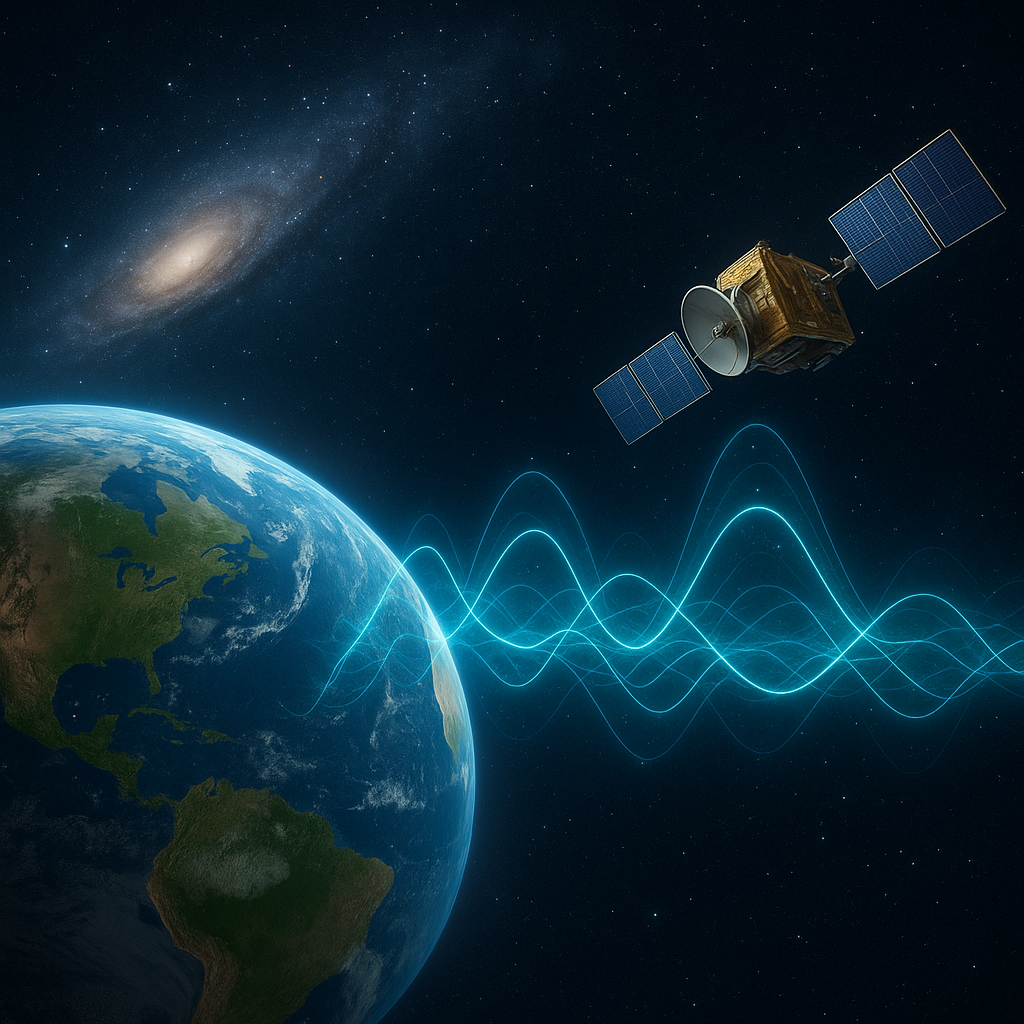
One notable mission transmitted entangled photon pairs between a low Earth orbit satellite and two ground stations separated by over 1,200 kilometers. Measurements confirmed the preservation of entanglement fidelity and the robustness of QKD protocols under variable weather and orbital conditions.
Advantages Over Classical Methods
Quantum communication promises to address critical bottlenecks in space data transfer. The most compelling advantages include:
- Bandwidth Expansion – By encoding information into qubits and entangled states, quantum channels can support higher data throughput compared to microwave or traditional optical links.
- Latency Reduction – Although the speed of light imposes a fundamental limit, quantum teleportation protocols could minimize intermediate processing delays in long-haul transmissions.
- Unbreakable Security – QKD ensures that any interception attempt introduces detectable anomalies, providing real-time alerts and rendering espionage virtually impossible.
- Resistance to Jamming – Quantum channels are inherently immune to most forms of electronic jamming, as the act of interference collapses the quantum state, signaling a breach.
These benefits become especially significant for deep-space missions, such as robotic explorers on Mars or beyond, where classical links suffer from low data rates, high latency, and vulnerability to solar flares or cosmic radiation.
Technical Challenges and Future Outlook
Despite the promise, several obstacles must be overcome before quantum communication becomes standard in space operations:
- Photon Loss and Decoherence – Traversing Earth’s atmosphere or interplanetary space exposes entangled photons to scattering and phase disturbances, reducing link fidelity.
- Precision Pointing – Maintaining alignment between rapidly moving satellites and ground stations demands sub-microradian accuracy for optical beam steering.
- Quantum Repeater Deployment – Establishing repeater nodes in orbit or at strategic celestial waypoints remains a complex engineering challenge, requiring robust cryogenic and vacuum systems.
- Resource Constraints – Spacecraft have limited power and payload mass, necessitating miniaturization of quantum hardware without sacrificing performance.
Ongoing research focuses on ultra-stable photonic integrated circuits, adaptive optics to mitigate atmospheric effects, and novel entanglement-generation schemes that operate at higher wavelengths. Private companies and space agencies are also collaborating to launch constellations of quantum-enabled satellites, aiming to demonstrate a global quantum backbone for both space and terrestrial networks.
Looking Ahead
The integration of quantum communication into space infrastructure could redefine the way humanity explores the cosmos. Imagine swarms of probes exchanging real-time scientific data from the outer planets or a resilient quantum internet linking astronauts on the Moon with mission control on Earth. While significant hurdles remain, multidisciplinary efforts spanning physics, engineering, and cybersecurity are converging to make this vision a reality. As quantum technologies mature, the final frontier may soon harness the strange laws of quantum mechanics to unlock a new era of deep space connectivity.