
The shadow of the Moon sweeping across Earth has fascinated observers for millennia. Predicting when and where a solar eclipse will occur requires a blend of ancient wisdom, rigorous mathematical frameworks, and cutting-edge technology. By studying orbital whispers and cosmic alignments, astronomers can forecast these breathtaking events with astonishing accuracy. This article explores the journey from rudimentary skywatching to advanced computational forecasting, shedding light on how experts unveil the secrets of each eclipse.
Historical Foundations of Eclipse Prediction
The earliest eclipse forecasts originated in Mesopotamia, where Babylonian scholars recorded thousands of lunar and solar events on clay tablets. By recognizing patterns repeating every 18 years, 11 days, and 8 hours, they discovered what is now known as the Saros cycle. Ancient Chinese astronomers improved on these predictions by integrating refined lunar tables, while Greek thinkers such as Hipparchus applied geometric models to refine timing calculations. Despite lacking telescopes, these pioneers laid the groundwork for modern eclipse science through careful observation, record-keeping, and an intuitive grasp of recurring celestial rhythms.
Fundamentals of Celestial Mechanics and Orbital Dynamics
At the heart of eclipse forecasting lies celestial mechanics, the branch of physics that describes how gravitation governs the motion of heavenly bodies. Newton’s law of universal gravitation provides the mathematical backbone, enabling scientists to compute the Moon’s orbit around Earth and Earth’s orbit around the Sun. By accounting for perturbations caused by other planets, tidal forces, and the Earth’s equatorial bulge, researchers build intricate models of orbital dynamics. These models form the basis for today’s high-precision predictions, ensuring that even slight deviations in trajectory are anticipated well in advance.
Modern Forecasting Techniques
Thanks to powerful computers, astronomers now rely on numerical simulation and computational models to generate eclipse predictions. Institutions like NASA’s Jet Propulsion Laboratory maintain detailed ephemerides—tables listing the positions of celestial objects at specific times. Software packages ingest these ephemerides to calculate contact times, durations, and the exact path of totality or annularity. The United States Naval Observatory and various national observatories publish annual data in an astronomical almanac, offering both professionals and enthusiasts vital information on upcoming eclipses worldwide.
Geometry of Umbra and Penumbra Paths
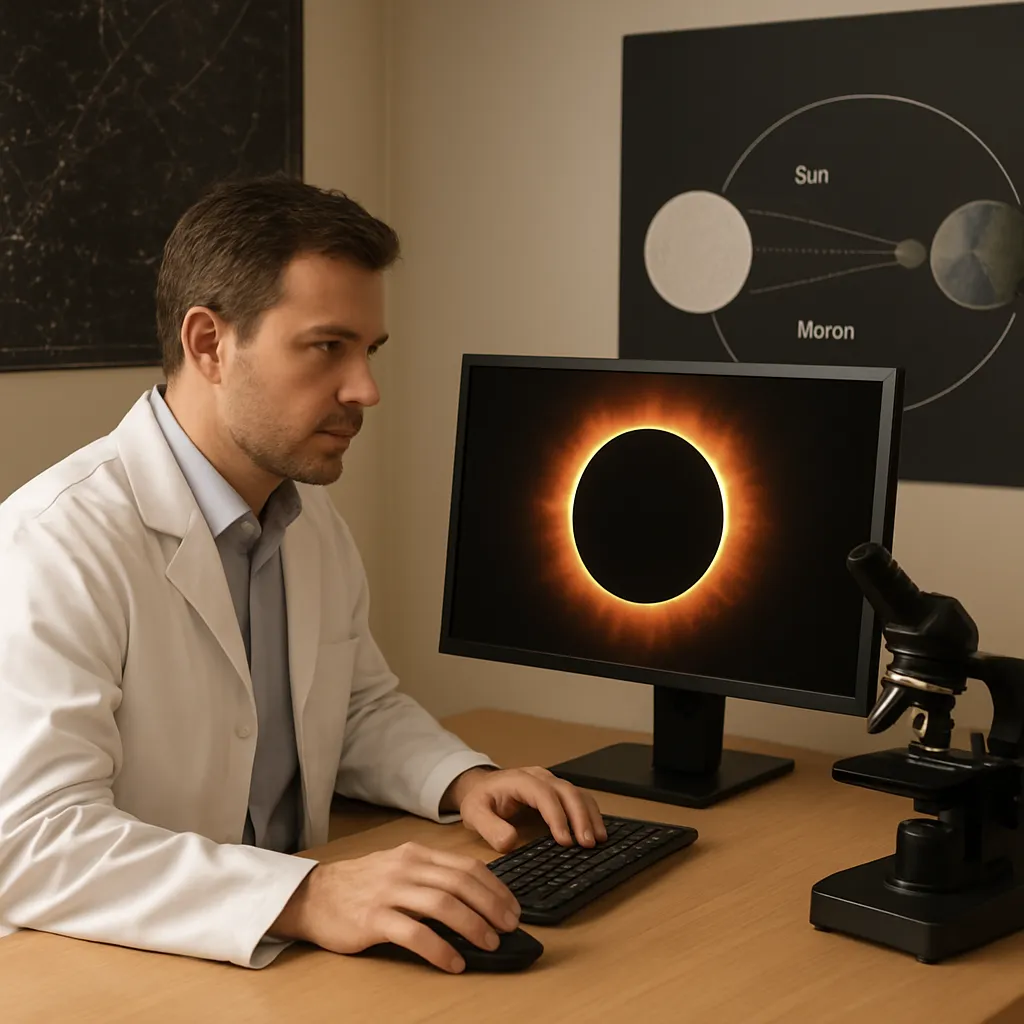
Understanding the interplay between the Moon’s shadow regions—the umbra and penumbra—is essential for mapping eclipse routes. Observers standing in the umbra witness totality, where the Moon completely obscures the Sun and reveals the solar corona. Those in the penumbral zone see a partial eclipse, with the Sun only partly covered. By projecting conical shadow shapes onto Earth’s surface and correcting for atmospheric refraction, scientists trace narrow corridors of totality that can span thousands of kilometers but only a few hundred kilometers wide. These projected tracks are updated continuously as models improve.
Tools and Instruments Enhancing Precision
- High-resolution telescopes equipped with solar filters capture precise celestial coordinates, refining orbital parameters.
- Global networks of radio interferometers monitor subtle variations in the Moon’s velocity and distance, improving time estimates.
- Satellite missions like the Lunar Reconnaissance Orbiter measure topography on the Moon’s limb, reducing uncertainties in shadow edge calculations.
- Ground-based photometers and spectrometers record solar irradiance changes during eclipses, validating predictions of eclipse magnitude and duration.
- Supercomputers run millions of simulations, merging data from past observations with theoretical models to enhance overall predictability.
The Saros Cycle and Long-Term Planning
The interplay of three fundamental periods—the synodic month (new Moon cycle), draconic month (node crossing), and anomalistic month (perigee cycle)—gives rise to the Saros cycle. After one Saros, the Earth-Moon-Sun geometry nearly repeats, producing an eclipse family with similar characteristics. By cataloging Saros series, astronomers can forecast eclipses centuries in advance. This long-term planning aids governments and scientific teams in scheduling observation campaigns, designing specialized instruments, and organizing public outreach events to share the marvel of total and annular eclipses with broader audiences.