


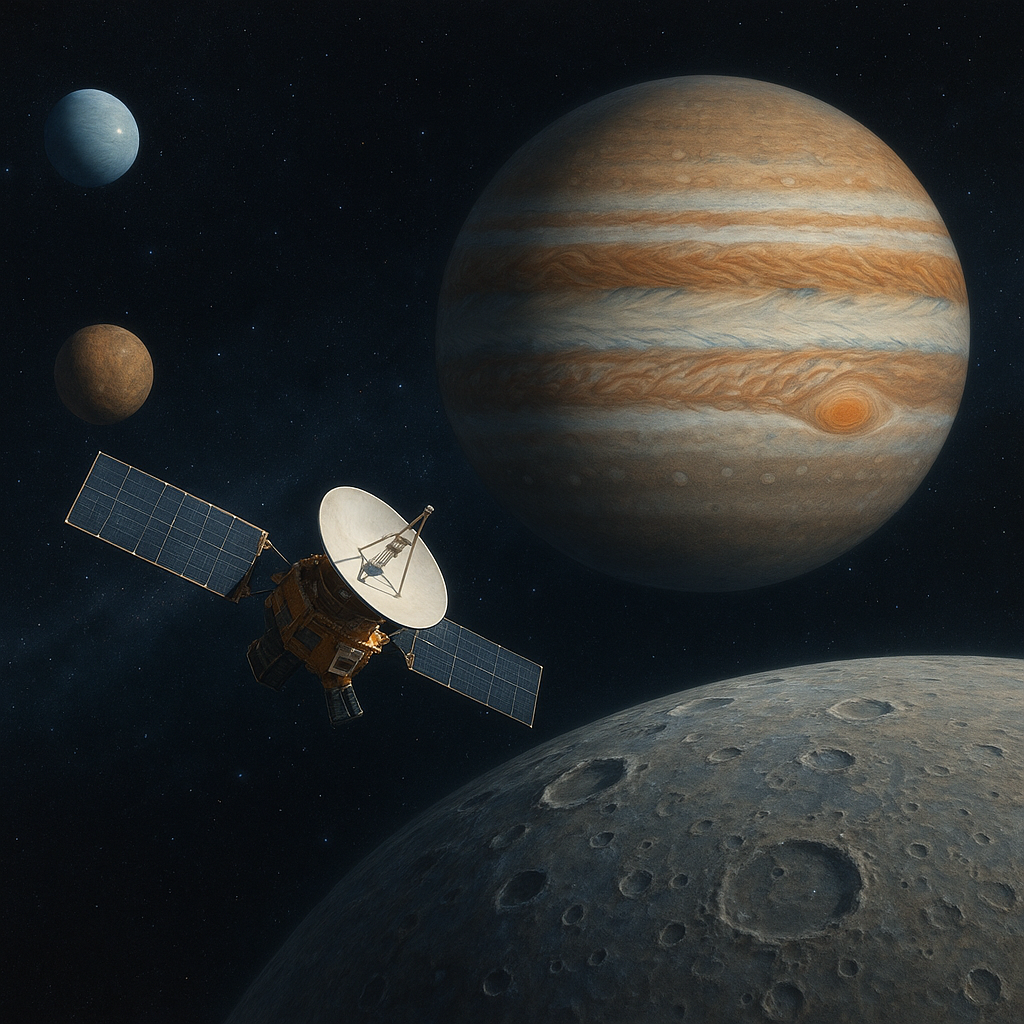
Embarking on a journey beyond the familiar planets of our neighborhood reveals a realm of untapped marvels waiting to transform our understanding of the cosmos. This article delves into the compelling reasons why humanity must pursue the exploration of the outer solar system, examining the scientific, technological, economic, and inspirational dimensions of this grand endeavor.
Unraveling Scientific Mysteries
The outer solar system—home to Jupiter, Saturn, Uranus, Neptune, and their numerous moons—offers a laboratory for testing fundamental theories about the universe. Each world carries distinct clues about planetary formation, chemistry, and potential habitats for extraterrestrial life. By sending probes and orbiters to these distant realms, scientists can:
- Study the atmospheric dynamics of gas giants, revealing insights into weather systems far more massive and complex than Earth’s.
- Investigate icy moons such as Europa and Enceladus, whose subsurface oceans are prime targets for astrobiology and the search for microbial life.
- Measure magnetic fields and radiation belts, deepening our grasp of planetary magnetospheres and their protective roles against cosmic radiation.
- Analyze the composition of Kuiper Belt Objects and dwarf planets like Pluto, shedding light on the building blocks of the solar system.
Data returned from missions such as Galileo, Cassini, Juno, and New Horizons have already revolutionized our knowledge. Yet, they represent only the first steps. New missions equipped with advanced sensors, sample collection systems, and possibly landers will unlock secrets that no Earth-bound telescope can reveal. Understanding these worlds refines models of solar system evolution and guides our search for life throughout the galaxy.
Technological Innovation and Engineering Triumphs
Pushing spacecraft billions of kilometers into deep space demands breakthroughs in propulsion, power generation, communication, and materials science. The challenges of extreme cold, high radiation, and vast distances have driven engineers to develop:
- Radioisotope Power Systems (RPS) capable of supplying steady energy where sunlight is too faint for solar panels.
- Ion and Hall-effect thrusters that use charged particles for efficient long-duration propulsion.
- Advanced radiation-hardened electronics and autonomous navigation systems to ensure mission resilience.
- Deep-space communication networks with large high-gain antennas, enabling data relay across billions of kilometers.
These innovations have applications far beyond spaceflight. Improvements in high-efficiency power sources, miniaturized sensors, and robust robotics can benefit renewable energy, medical imaging, and even disaster response here on Earth. The endeavor to visit distant moons and planets thus becomes a catalyst for broad-based innovation, spurring breakthroughs that ripple through multiple industries.
Economic Potential and Resource Utilization
While the initial investment in outer solar system missions is substantial, the long-term economic gains can be significant. Abundant volatiles—such as water ice—on moons like Europa, Ganymede, and Titan could serve as propellant, drinking water, and life-support resources for future human outposts. Likewise, the ice-rock composition of Kuiper Belt Objects holds promise for mining operations that extract hydrogen, oxygen, and other elements critical for sustaining interplanetary travel.
The emerging field of in-situ resource utilization (ISRU) envisions harvesting materials on other worlds to reduce launch mass and cost from Earth. Potential benefits include:
- Lowering the price of deep-space missions through local production of fuel and supplies.
- Creating economic opportunities for private-sector companies in areas such as automated mining, processing, and orbital manufacturing.
- Fostering a new space economy that supports both research and commercial ventures, leading to job creation and technological spin-offs.
By establishing the necessary infrastructure for resource extraction and processing, we move closer to a sustainable off-world economy—one that can relieve burdens on Earth’s finite reserves and open up new frontiers for human settlement and commerce.
Societal Inspiration and Global Collaboration
Throughout history, great journeys have united humanity under a banner of shared curiosity and ambition. Missions to the outer solar system serve as modern-day equivalents of these epic voyages. They capture the public imagination, inspire future generations to pursue careers in science, technology, engineering, and mathematics, and demonstrate what we can achieve when nations pool resources and expertise.
The international nature of flagship missions—from planning and funding to construction and data analysis—establishes frameworks for collaboration that transcend geopolitical boundaries. Programs like the Europa Clipper involve contributions from NASA, ESA, and partner nations, showcasing how collective efforts lead to more capable and cost-effective exploration.
Moreover, the stunning images and scientific revelations from these missions foster a sense of unity and perspective. Viewing Saturn’s rings through the Cassini lens or witnessing Jupiter’s swirling storms via Juno’s eyes offers a humbling reminder of our place in the cosmos, promoting a global ethos of stewardship for our home planet.
Looking Ahead: Ambitious Missions on the Horizon
The next decade promises an exciting roadmap of missions that will push deeper into the solar system than ever before:
- Europa Clipper: A mission dedicated to exploring Europa’s icy crust and subsurface ocean, assessing its habitability potential.
- Dragonfly: A rotorcraft lander designed to explore the hydrocarbon lakes of Titan, investigating prebiotic chemistry and surface processes.
- Uranus Orbiter and Probe: A proposed mission aiming to study the ice giant’s atmosphere, magnetosphere, and ring system in unprecedented detail.
- Trident: A concept for a flyby of Neptune’s largest moon, Triton, to evaluate cryovolcanism and surface geology.
These ambitious projects demand sustained commitment from space agencies, academic institutions, and industry partners. The rewards, however, are immeasurable: a clearer understanding of planetary processes, potential detection of extraterrestrial organisms, and the technological prowess to support human expansion into deeper space.
The quest to explore the outer solar system embodies humanity’s enduring drive to expand the frontiers of knowledge. By pursuing this path, we not only satiate our innate curiosity but also lay the groundwork for a future where the cosmos becomes an arena of cooperative scientific endeavor, economic vitality, and boundless inspiration.