The Voyager missions stand as some of the most ambitious and enduring endeavors in space exploration. Launched at the brink of the 1970s, these twin probes have journeyed farther than any other human-made spacecraft, revealing astonishing insights into our solar system and beyond. Their voyage continues to reshape our understanding of planetary science, the nature of the interstellar environment, and humanity’s capacity for innovation.
Voyager Launch and Mission Objectives
The primary goal of the Voyager program was to take advantage of a rare planetary alignment that occurs once every 176 years. By employing gravitational assist maneuvers, each probe would slingshot from one giant planet to the next, maximizing scientific returns while minimizing travel time and propellant needs. Voyager 2 lifted off on August 20, 1977, followed by Voyager 1 on September 5, 1977. Although Voyager 1 launched later, its trajectory was more direct, allowing it to overtake its twin.
Engineers and scientists equipped each probe with a suite of instruments designed to measure magnetospheres, particle environments, and atmospheric properties. Notably, the inclusion of the Golden Record—a phonograph record containing sounds and images selected to portray the diversity of life and culture on Earth—gave the mission a profound message of cosmic outreach.
Key Instruments and Innovations
- Imaging Science Subsystem: captured detailed photographs of planetary surfaces and rings.
- Plasma Spectrometer: analyzed solar wind and plasma interactions.
- Cosmic Ray Subsystem: detected high-energy particles traversing the solar system.
- Magnetometer: examined magnetic fields around planets and in interplanetary space.
Thanks to these tools, the Voyagers became floating laboratories, continuously sending data back to Earth via the Deep Space Network. Despite their modest power source—a pair of radioisotope thermoelectric generators—they remain operational over four decades later.
Revelations about the Outer Planets
Prior to Voyager, the outer planets were little more than bright disks in telescopes. The missions delivered the first close-up views of Jupiter, Saturn, Uranus, and Neptune, profoundly altering our conception of the outer planets and their moons.
Jupiter’s Dynamic Environment
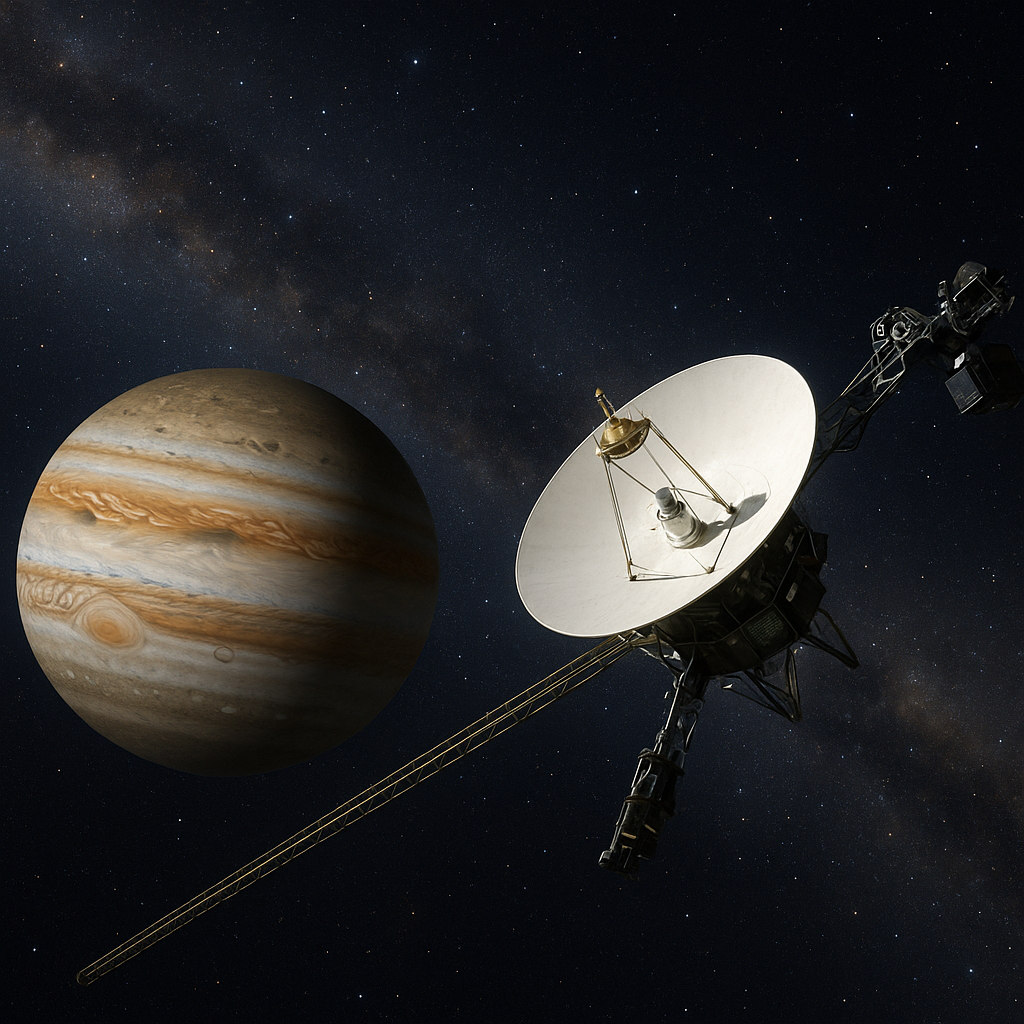
Voyager 1’s flyby of Jupiter in March 1979 revealed active volcanism on Io, caused by intense tidal heating. This discovery marked Io as the most geologically active body in the solar system. The spacecraft also captured the intricate patterns of Jupiter’s rings, the turbulence of its colorful clouds, and the vast extent of its magnetosphere.
Saturn’s Rings and Moon Diversity
In November 1980, Voyager 1 approached Saturn, providing unprecedented images of its rings. Scientists observed complex structures, such as braids, spokes, and waves driven by gravitational interactions with embedded moonlets. Titan, Saturn’s largest moon, was found to possess a dense atmosphere. Although the haze prevented surface imaging, the thick envelope of nitrogen and methane hinted at prebiotic chemical processes.
Uranus and Neptune: Ice Giants Unveiled
Voyager 2 remains the only spacecraft to have visited Uranus (January 1986) and Neptune (August 1989). These giants, composed largely of ices—water, ammonia, and methane—displayed unexpected characteristics:
- Uranus’s extreme axial tilt, causing dramatic seasonal shifts.
- Neptune’s supersonic winds, the fastest measured in the solar system.
- Triton’s geysers of nitrogen gas, indicating internal heat sources.
Detailed observations of their magnetic fields and ring systems enriched models of planetary formation and evolution, demonstrating that ice giants are distinct from gas giants and terrestrial worlds alike.
Crossing the Heliosphere into Interstellar Space
One of the most remarkable achievements of the Voyager probes has been the traversal of the heliosphere boundary. The heliosphere is a vast bubble inflated by the solar wind, shielding the solar system from a substantial portion of galactic cosmic rays.
Voyager 1: The First Interstellar Ambassador
On August 25, 2012, Voyager 1 officially entered interstellar space, defined by a sharp drop in solar wind particle density and a rise in cosmic rays originating beyond our Sun. Measurements revealed that the spacecraft had passed through the heliopause—the interface where the solar wind’s outward pressure equals the interstellar medium’s inward pressure.
Data collected in this region uncovered the presence of plasma oscillations, magnetic fluctuations, and the composition of interstellar particles. These findings challenged preexisting theoretical models and offered the first in-situ information about the galactic environment surrounding us.
Voyager 2’s Twin Milestone
Voyager 2 followed its sibling into interstellar space on November 5, 2018. Despite sharing many instruments, Voyager 2’s unique trajectory provided complementary data, especially concerning the asymmetry of the heliosphere. Comparing the two probe’s observations allowed scientists to create a three-dimensional map of the heliospheric boundary and better understand how the solar wind interacts with the interstellar medium.
- Confirmation of a thicker heliosphere “nose” facing the Sun’s motion through space.
- Detection of solar wind changes over three solar cycles.
- Insights into the filtration of interstellar particles by the heliospheric boundary.
Legacy and Future Prospects
More than four decades after their launch, Voyager 1 and Voyager 2 continue to transmit precious scientific information. Their longevity underscores the ingenuity of mission designers and the resilience of robust engineering. Each bit of data streaming back expands our understanding of both the solar system’s frontier and the wider galactic neighborhood.
The success of the Voyager missions laid the groundwork for future interstellar probes. Concepts like the Interstellar Probe mission build upon their achievements, aiming to carry more advanced instruments deeper into the galaxy. Meanwhile, the Golden Records aboard each Voyager remain silent ambassadors, drifting through the void as a testament to humanity’s spirit of exploration.
Ultimately, the Voyager missions have not only unveiled the wonders of distant worlds and the nature of space beyond the Sun’s influence—they have also inspired generations to look upward and imagine the possibilities that lie at the very edge of the unknown.