

The vast expanse beyond our planet holds untold opportunities, and among the most tantalizing is the potential to harvest raw materials from the countless celestial bodies orbiting the Sun. As Earth’s demand for metals and minerals grows, the idea of extracting resources from asteroids has shifted from science fiction to a plausible enterprise. This exploration promises to revolutionize industries on Earth and accelerate humanity’s march into the cosmos.
Origins and Composition of Asteroids
Asteroids are remnants of the early Solar System, composed of rock, metal, and volatile compounds. Classified into three main types—C-type, S-type, and M-type—they vary in their content and accessibility. Carbonaceous C-types contain water and organic compounds, essential for supporting future space habitats. Silicaceous S-types boast valuable minerals like iron and magnesium, while metallic M-types are rich in nickel and platinum-group metals.
Studying asteroids requires advanced observational techniques, including spectroscopy and radar mapping. Space agencies deploy probes to measure composition and rotation. Bodies like 16 Psyche, with an estimated $10,000 quadrillion worth of metals, highlight the sheer potential locked within these space rocks. Unraveling their origin and structure offers crucial insights for safe extraction.
Classification and Discovery
- C-type: The most common, dark and carbon-rich.
- S-type: Brighter, with silicate minerals and metals.
- M-type: Rare, metallic, offering high concentrations of precious elements.
New telescopic surveys and deep-space missions continuously expand our asteroid catalog, enabling precise navigation to promising targets. Understanding an asteroid’s spin axis, mass distribution, and surface geology is vital for mission planning.
Technological Challenges in Space Mining
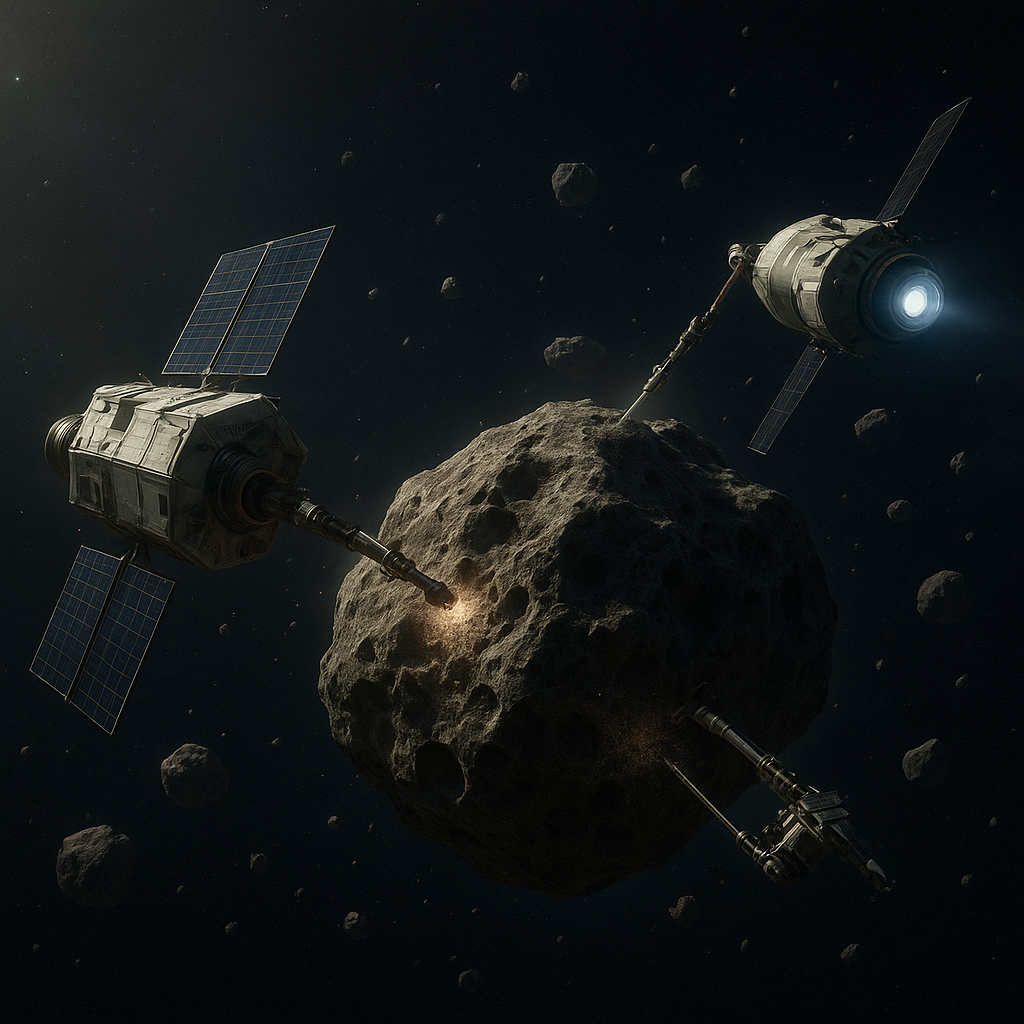
Mining asteroids presents formidable engineering hurdles. Traditional earthbound techniques cannot be directly transplanted into microgravity and vacuum. Innovative solutions must address anchoring tools to surfaces with minimal gravity, handling regolith without producing hazardous debris, and transporting extracted materials back to orbit.
Propulsion systems for deep-space travel require high efficiency. Solar electric propulsion and nuclear thermal rockets offer promising thrust-to-fuel ratios. Autonomous robotics will perform most excavation tasks, reducing human risk in harsh environments. Rovers and drones equipped with advanced sensors, drills, and collection bins are under development to operate semi-independently.
Excavation and Processing Methods
- Regolith heating to extract water and volatiles.
- Magnetic separation for metallic ores.
- 3D printing with in-situ materials to build structures.
Extracting water from asteroids could revolutionize in-space life support and fuel production, enabling spacecraft refueling at asteroid-based depots. This game-changing approach reduces dependence on Earth-launched propellant and paves the way for sustained deep-space exploration.
Economic Impact and Future Prospects
The prospect of space mining has captured the attention of private firms and governments alike. Companies plan to secure exclusive rights to mine asteroids, with projected returns that dwarf traditional mining ventures. Metal prices on Earth may shift dramatically if large quantities of platinum-group metals enter the market, potentially lowering costs for electronics and green technologies.
Beyond raw materials, asteroid mining can spur new industries: orbital construction using in-situ resources, production of solar arrays in space, and manufacturing scientific instruments on-site. The reduction in launch mass from Earth translates to lower costs and increased sustainability for space missions.
- Investment: Billions of dollars in venture capital have flowed into space resource startups.
- Spin-offs: Technologies developed for asteroid mining benefit terrestrial industries, such as robotics and remote sensing.
- Collaboration: International partnerships leverage collective expertise and share risks.
The emerging market for space-based resources is expected to reach tens of billions annually by mid-century. Success will depend on viable extraction rates, reliable transport logistics, and long-term mission endurance against cosmic radiation and micrometeoroids.
Legal and Ethical Considerations
The legal framework for asteroid mining is still evolving. The Outer Space Treaty of 1967 proclaims that celestial bodies are not subject to national appropriation, yet it remains silent on resource extraction rights. New legislation in some countries, like the U.S. Commercial Space Launch Competitiveness Act, grants companies the right to ownership of resources they mine, sparking debate among the international community.
Ethical questions also arise. Who decides on the environmental impact of space mining? Could aggressive extraction alter the orbit or stability of asteroid bodies, posing risks to Earth? Ensuring that operations respect planetary defense protocols and avoid unintended collisions is paramount.
Fair Access and Governance
- Equitable resource sharing among nations.
- Standardizing safety and environmental guidelines.
- Establishing an international registry for mining claims.
Creating a transparent system for permits and dispute resolution will encourage responsible development. Collaborative treaties, akin to maritime law on Earth’s oceans, may provide a blueprint for space resource governance.
Emerging Trends and Next Steps
Looking ahead, advances in artificial intelligence and machine learning will optimize mission planning, target selection, and operational efficiency. Robotic fleets, leveraging swarm intelligence, could survey thousands of asteroids simultaneously, prioritizing those with the highest yield-to-cost ratio.
Collaborative missions between space agencies and private entities will set the stage for full-scale mining operations. Experimental demonstration flights, resource extraction prototypes, and in-orbit material processing plants will validate concepts and attract larger investments.
As humanity extends its reach into the Solar System, asteroid mining symbolizes our drive to harness the cosmos for the benefit of all. The convergence of technology, policy, and vision may soon unlock the resources of these wandering rocks, forging a new era of exploration and opportunity.