

Imagine a future where massive towers stretch from Earth’s surface into the sky, allowing vehicles to climb a tether instead of launching via rockets. This vision of the space elevator has captivated scientists and science fiction writers alike, promising to revolutionize how humanity reaches orbit. By eliminating much of the fuel requirements and complex staging currently used in rocket launches, the space elevator could become a cornerstone of our cosmic ambitions.
Overview of How Space Elevators Work
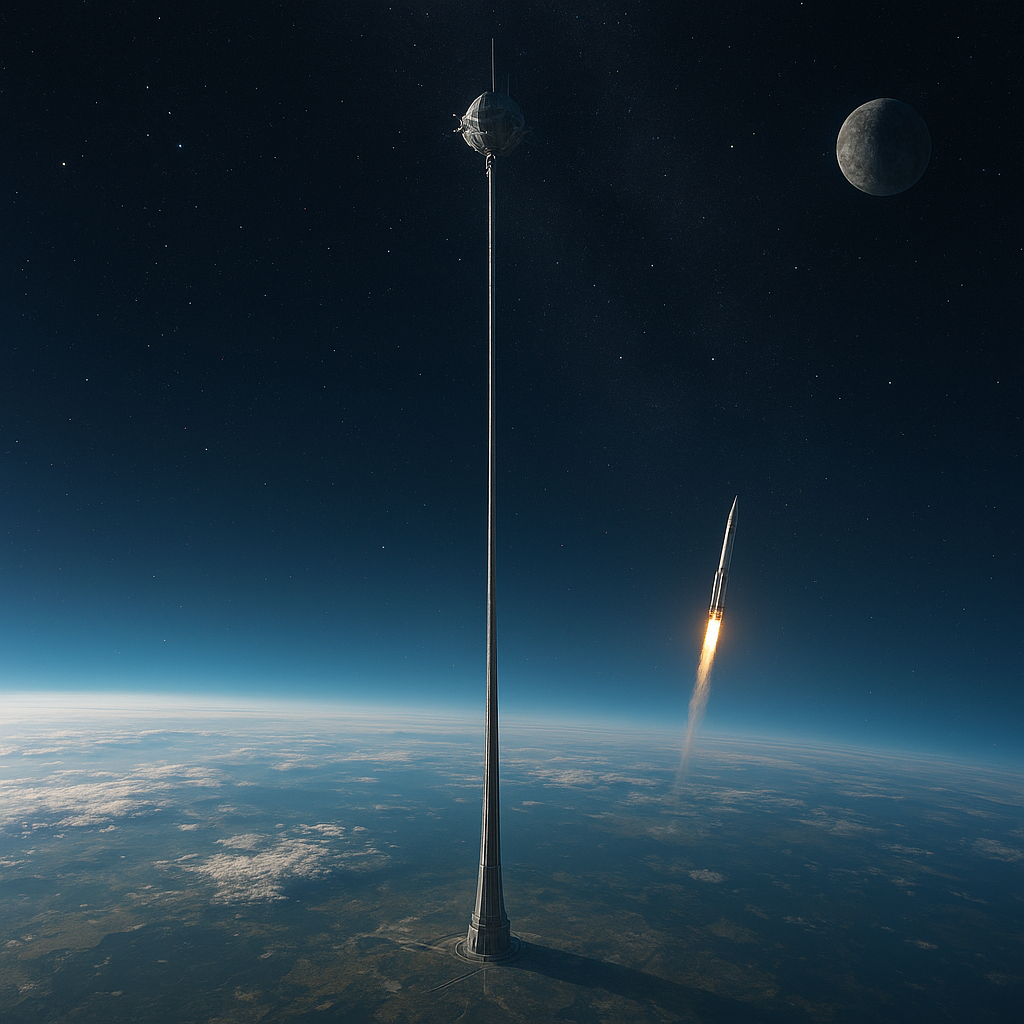
A space elevator is essentially a cable or ribbon anchored at Earth’s equator and extended beyond geostationary orbit, approximately 35,786 kilometers above sea level. The principle relies on the balance between Earth’s gravitational pull and the centrifugal force experienced by the cable’s tip as it rotates with the planet. Climbers, or elevator cars, would ascend and descend along this tether, carrying cargo and passengers. By tapping into electrical or laser-powered drive systems, climbers could steadily propel themselves upward, delivering payloads into orbit with unprecedented efficiency.
Key components of the system include a ground-based anchor station, a counterweight beyond geostationary altitude, and the tether itself. Unlike rockets, the climbers would not jettison stages or expel enormous quantities of propellant. Instead, they would draw power from the ground or directly from beamed energy, significantly reducing environmental impact and launch costs.
Material Breakthroughs and Engineering Hurdles
The greatest obstacle to constructing a space elevator has always been material science. To support its own weight and the weight of climbers, the cable must exhibit extraordinary tensile strength while remaining lightweight. Traditional materials like steel or Kevlar simply cannot meet the required strength-to-mass ratio.
Over the past two decades, research into carbon nanotubes and graphene composites has offered new hope. These nanomaterials demonstrate theoretical strength thousands of times greater than steel at a fraction of the mass. Yet challenges remain: manufacturing continuous ribbons hundreds of kilometers long, ensuring defect-free alignment, and protecting the material from micrometeoroid impacts or atomic oxygen erosion in low Earth orbit.
Simultaneously, advanced monitoring systems and self-repair mechanisms are under development to maintain tether integrity. By embedding sensor networks within the cable, engineers could detect stress fractures and dispatch robotic maintenance climbers to apply localized repairs, ensuring continuous, safe operation.
Construction and Deployment Strategies
- Anchoring the base: A seafaring platform near the equator would host the anchor station, ensuring stability and minimizing geopolitical complications on land.
- Deploying the tether: Initial cable segments could be carried into orbit by conventional rockets or reusable launch vehicles, then spliced together to form a continuous ribbon.
- Adding counterweight: The tether’s far end could attach to a captured asteroid or a purpose-built station, creating the necessary outward force to keep the cable taut.
Each phase requires international coordination, rigorous testing, and incremental risk management. Once functional, the tether could support climbers with increasing payload capacity, eventually scaling to hundreds of metric tons per trip.
Economic Impact and Revolutionizing Launch Costs
Cost Reduction Analysis
Traditional rocket launches can cost from $5,000 to $20,000 per kilogram to low Earth orbit. A fully operational space elevator could theoretically reduce this to under $100 per kilogram, transforming industries and opening space to new markets. By shifting from chemical propulsion to cost-effective electric or laser-driven ascent, launch operators would save on fuel, maintenance, and turnaround time.
This dramatic cost reduction would spur a range of economic activities:
- Commercial satellite deployment at lower prices, encouraging broadband constellations and Earth observation networks.
- Manufacturing of high-value materials in microgravity, such as specialized crystals and pharmaceuticals.
- Harvesting solar power satellites, beaming energy back to Earth to help address climate change and energy shortages.
By enabling frequent, reliable access to orbit, the space elevator could also lower insurance costs and mitigate launch delays caused by weather or technical setbacks typical of rocket liftoff windows.
Challenges, Risks, and Mitigation Plans
Despite its promise, the space elevator concept faces significant hurdles beyond material science. Orbital debris poses a constant threat; even small fragments traveling at orbital velocities can inflict catastrophic damage on the tether. To mitigate this risk, space traffic management protocols and active debris tracking must advance in parallel. Concepts include deploying shield layers or using magnetic fields to deflect charged particles.
Other concerns involve space weather and solar storms, which could induce currents along the cable and disrupt climber electronics. Protective coatings, grounding systems, and real-time monitoring of the orbital insertion environment will be essential. Furthermore, ensuring security against sabotage or terrorist action demands robust governance frameworks and international collaboration on space infrastructure protection.
Future Applications and Visionary Prospects
Once established, a network of space elevators could serve as a backbone for humanity’s expansion beyond Earth. Routine transport of supplies and crew to orbital habitats would fuel the growth of permanent research stations, manufacturing modules, and even touristic facilities in space. The reduced cost barrier could ignite a new era of space tourism, where ordinary citizens experience microgravity without the extreme G-forces of a rocket launch.
Moreover, the tether could function as a launch platform for deep space missions. By traveling up the cable, spacecraft could embark on interplanetary journeys with minimal onboard fuel reserves, relying instead on orbital mechanics and solar electric propulsion. This approach might unlock faster transit to Mars, asteroids, and beyond, reshaping our approach to exploration.
In the long term, the space elevator concept stands as a testament to human ingenuity, bridging the gap between Earth and the cosmos. Through sustained investment, research, and global cooperation, the once-fantastical idea of climbing a ribbon to the heavens may soon become an integral part of our spacefaring future.